Get Full Government Meeting Transcripts, Videos, & Alerts Forever!
Get email alerts on the Water Finance topic
No spam. Unsubscribe anytime.
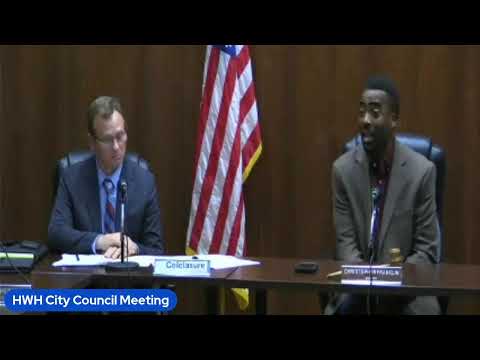
State officials tell Helena council $11 million loan will require higher rates; two-year water phase recommended
Summary
State loan and rate-study officials told the Helena council an approved $11,000,000 drinking-water loan has not closed and will add debt service the city must account for; the rate study recommends phasing water rates to $7.39 per 1,000 gallons (two years) and raising sewer from $1.82 to $2.82 to cover shortfalls and qualify for principal forgiveness.
City officials and state loan staff told the Helena council that a previously approved $11,000,000 drinking-water loan has not closed and that the city must adopt a rate ordinance and supply project plans before the state will disburse funds.
The council heard a rate-study presentation that used city-supplied numbers and found water revenues of $1,955,267 against water expenses of $2,697,675 for the 12-month period reviewed, producing a shortage of $1,176,063. The presenter said the study did not include the potential $11,000,000 loan and recommended phasing the water increase in two steps: a first-year rate of $5.06 per 1,000 gallons and a second-year rate of $7.39 per 1,000 gallons. For sewer, the study recommended raising the cost-per-thousand from $1.82 to $2.82.
The state loan official explained underwriting assumptions and timing. The city has approval for up to $11,000,000 but has not spent funds and is not on the hook until closing, the official said; underwriting on a 20-year term at 4% produced a working estimate that the added debt could imply roughly a 58% increase in rates depending on amortization and scope. At closing the state will require plans and specifications, permits from relevant agencies, bond counsel to participate in closing, and a rate ordinance that reflects debt service. The official added that loans typically operate on a reimbursement schedule and interest accrues only on amounts the city has drawn.
Officials and council members discussed principal forgiveness, which the state considers once a year in November. The loan official said eligibility for the larger principal-forgiveness awards generally requires the city’s water rate-burden factor to reach about 1.25; the agency’s last calculation put the city at about 1.17. Because principal forgiveness is awarded from limited federal funds, acceptance for any future application will depend on how projects rank statewide at the November meeting.
Council members asked the rate-study presenter and state staff to revise the study to explicitly include scenarios that fold the $11,000,000 into rates; the presenter said he could provide updated numbers quickly and would work with the agency so the council and public could review revised estimates. Several council members emphasized the need for public hearings and transparent communication so customers understand the sources of increases.
State and agency staff repeatedly urged the council to have the city’s engineer develop prioritized plans and cost estimates so the state can evaluate project scopes and consider principal forgiveness. Officials also noted operational matters — recurring bypass pumps, aging distribution mains and valves, and an inadequately sized treatment plant — that must be addressed in project planning and that will affect funding decisions. The presenter recommended that once the phased increases are implemented the city adopt a modest annual escalation (the study recommended a 3% annual increase) rather than tying adjustments to a fluctuating CPI.
Next steps recorded in the meeting: the rate study will be revised to include the loan scenario; the state will provide amortization/underwriting numbers for meter sizes; the council was advised to secure bond counsel and to have the city engineer finalize project designs and cost estimates. The state official said some documents and a reimbursement plan will be required at closing and that repayment generally begins about two and a half years after loan closing.
The discussion concluded without the council taking any binding action on rates or borrowing at the meeting. The loan approval remains in place until the city completes closing requirements or de-obligates funds; principal-forgiveness decisions will be made at the state’s November funding round.