Get Full Government Meeting Transcripts, Videos, & Alerts Forever!
Get email alerts on the Water Rates And Loan topic
No spam. Unsubscribe anytime.
Helena officials outline $11 million water loan and phased rate hikes to address massive losses
Summary
State loan officers and the city—s rate-study presenter told the Helena City Council that an approved $11 million drinking-water loan remains unspent, that the system lost an estimated 73.5% of produced water in the study year, and that phased rate increases are needed to close a $1.18 million operating gap.
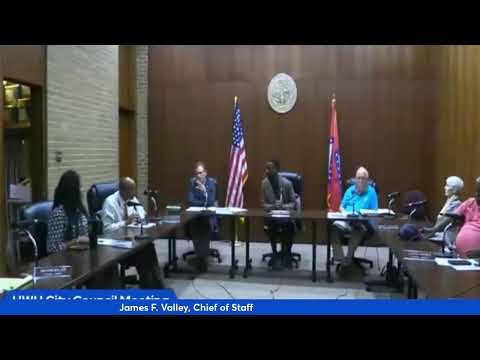
The Helena City Council heard from state loan staff and the consultant who prepared the city—s rate study about how an approved $11,000,000 drinking-water loan, escalating operating shortfalls and widespread leaks will shape upcoming rate decisions. Chris Callpleasure, director of the Natural Resources Division at the Arkansas Department of Agriculture, and the rate-study presenter answered council questions about timing, underwriting and conditions for principal forgiveness.
Callpleasure and the rate-study presenter said the city—s 12-month snapshot showed metered and nonmetered water revenue of $1,955,267 against expenses of $2,697,675, producing a $1,176,063 shortfall. "You had an expense of 2,697,675 ... that's where your rate is adjusted on your cost per thousand," the rate-study presenter said. The study found water production of 1,428,034,000 gallons and sales of 378,436,000 gallons, a loss rate of roughly 73.5% in the period analyzed.
To address that shortfall and to create funds for replacement and debt service, the presenter recommended phasing water rates: raise the cost per 1,000 gallons from the then-current $2.73 to about $5.06 in the first year and to $7.39 in the second year, with a 3% annual escalation thereafter. For sewer the study recommends increasing the cost per 1,000 gallons from $1.82 to $2.82 with a one-year implementation. The presenter said the study already included a prior $100,000 emergency loan but did not include the $11,000,000 loan that the city has been approved to receive.
Callpleasure explained how the $11,000,000 loan would factor into rates if the city borrows the full amount. Based on ANRC underwriting examples, "based on $11,000,000 over a 20 year term at 4%, you're looking at about a 58% increase," he said. He added that loan proceeds are disbursed on a reimbursement schedule tied to invoices, interest is charged only on the portion of the loan drawn, and repayment often does not start until roughly two to three years after closing.
Council members asked whether the rate study can be revised to incorporate the $11,000,000; the presenter said it can be updated and ANRC said it could provide per-meter underwriting figures promptly. "We can revise it," the presenter said, and ANRC said it had already underwritten the loan and could transition those numbers for the rate study.
Callpleasure and the presenter both emphasized that loan closing requires completed project plans and specifications, permits, and bond counsel, and that the city will typically need a rate ordinance as part of the closing package. Callpleasure also noted eligibility criteria for principal forgiveness: a policy measure commonly used by the agency is a rate-burden threshold of roughly 1.25% of median household income; Helena's water burden was calculated at about 1.17%, short of 1.25%. He cautioned the council that principal-forgiveness awards are decided once a year (the commission meeting in November was cited) and that even if the city qualifies it may receive partial forgiveness depending on funding availability and rankings.
Council members and staff urged clear public disclosure of combined, revised numbers so residents can understand the proposed increases and the tradeoffs between addressing operating shortfalls, funding pipe replacement and servicing new debt. One council member noted the city—s recent investments: a new well nearing completion funded from city cash (cited in the meeting at about $1,400,000), while others emphasized prior reliance on temporary bypass pumps and the need to move to pipe replacement.
Next steps identified in the meeting were: provide an updated rate study that incorporates underwriting for the $11,000,000, have the city engineer develop plans and cost estimates for prioritized work, retain bond counsel, and prepare the rate ordinance needed for loan closing and potential principal-forgiveness consideration. ANRC staff said they would email the council updated numbers and confirmed the commission meeting date for principal-forgiveness consideration (November 20 in Little Rock). The council did not adopt a rate ordinance during this session.
The loan and the recommended rate changes will return to council as staff and ANRC provide revised studies and underwriting details.