Get Full Government Meeting Transcripts, Videos, & Alerts Forever!
Get email alerts on the Water Quality topic
No spam. Unsubscribe anytime.
PUC accepts 2019 Public Health Goals report, flags six contaminants for follow up
Summary
The commission approved the 2019 Public Health Goals report covering 2016–2018 data; staff said six non‑enforceable public‑health goals were exceeded in samples (arsenic, bromate, chromium‑6, gross alpha, lead, total coliform) though regulatory limits were met; PUC directed more bromide/bromate monitoring and school/daycare follow up.
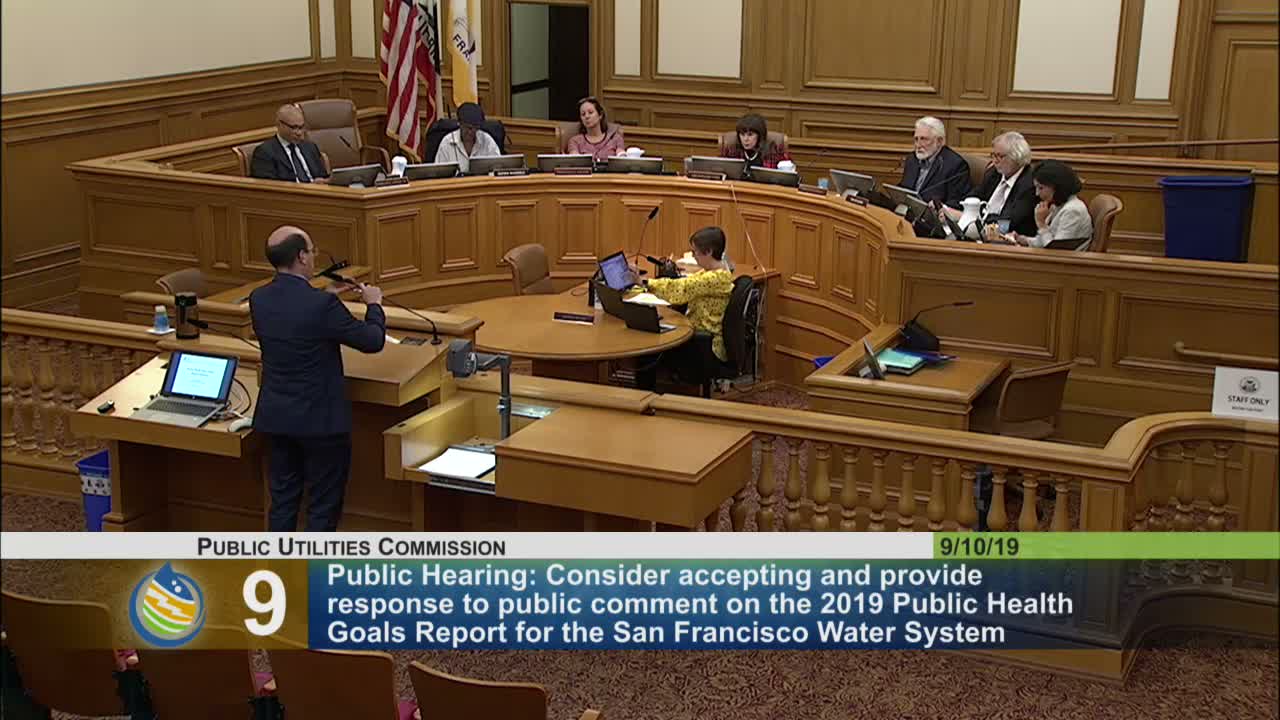
At a public hearing, the commission accepted the San Francisco Water System’s 2019 Public Health Goals report, which compares three years of monitoring data (2016–2018) to state public‑health goals (non‑enforceable health‑based benchmarks) and to regulatory standards.
Andrew DeGuassa, water quality division director, said staff reviewed 91 contaminants and that 85 fell within the "ideal" box between operational targets and regulatory limits. He identified six contaminants that exceeded the state’s public‑health goals during the reporting period: arsenic (detected at Calaveras), bromate (associated with ozonation at Harry Tracy Water Treatment Plant), chromium‑6 (detections at very low parts‑per‑trillion sensitivity), gross alpha (in one quarry pond), lead (generally associated with premise plumbing rather than distribution system), and total coliform (very low occurrences across roughly 10,000 samples).
DeGuassa outlined action items: increased bromide/bromate monitoring and optimization of ozone treatment if needed; continued watershed protection; a lead service inventory (estimated 3–4,000 services with possible lead components) and ongoing school and daycare testing and outreach; and coordination with public‑health partners for targeted community interventions. Commissioners asked about ammonia sources, school testing coverage and monitoring cadence; staff said all Unified School District schools and parochial schools have been tested and that private independent schools are about half complete.
The commission voted to accept the report and direct staff to notify the State Water Resources Control Board’s Division of Drinking Water that the hearing was conducted and the report is available.