Get Full Government Meeting Transcripts, Videos, & Alerts Forever!
Get email alerts on the Homelessness Policy topic
No spam. Unsubscribe anytime.
Coalition tells Police Commission citations escalate homelessness; urges dispatch reforms and services
Summary
A coalition report presented to the San Francisco Police Commission urged shifting nonemergency calls away from police, reducing citations and expanding services, saying enforcement costs the city about $20.6 million annually and that many people displaced by enforcement return to the street.
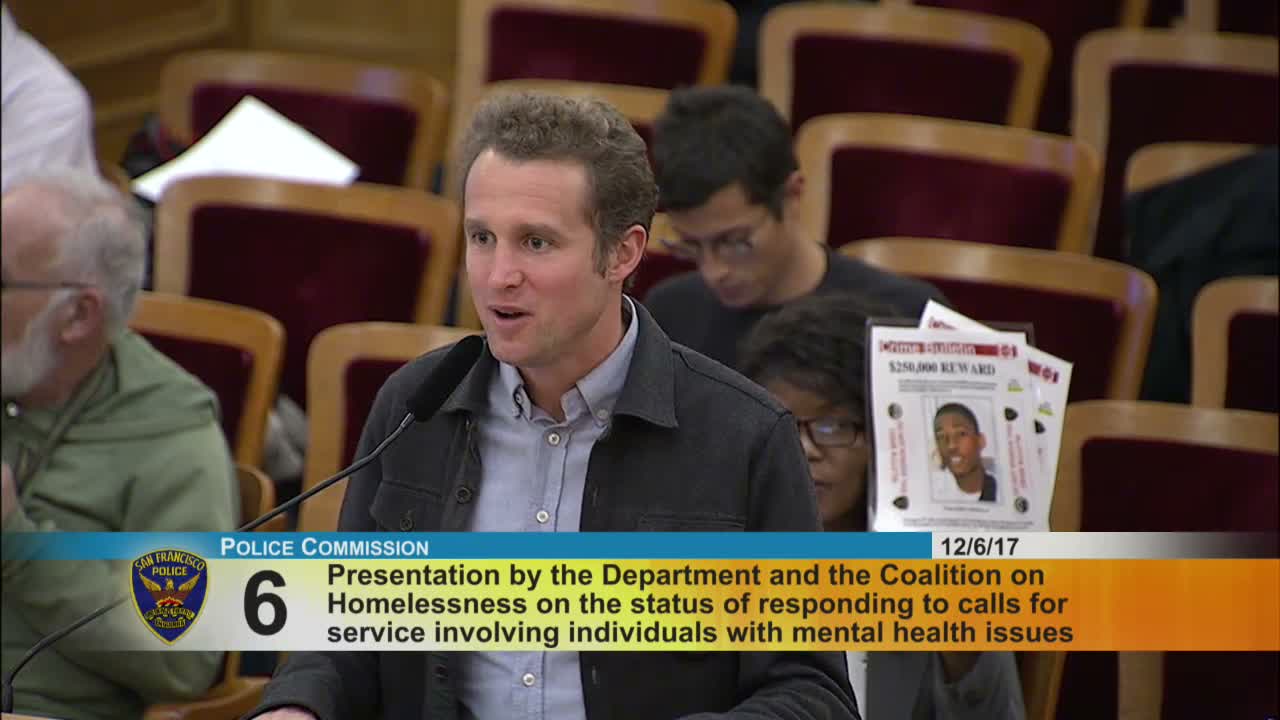
The Coalition on Homelessness and academic partners told the Police Commission on Dec. 6 that repeated enforcement of quality-of-life laws is costly and ineffective and can increase people—s vulnerability. Presenters cited a coalition-backed analysis that projected roughly 10,800 quality-of-life citations this year, of which about 6,700 were classified as "anti-homeless" citations, and a budget-analyst estimate that enforcement costs the city about $20.6 million annually, 90 percent of which were borne by the police department.
"Policing is not the solution to homelessness," said Chris Herring, a Ph.D. candidate at UC Berkeley who coauthored the study. He summarized survey work of 351 people and interviews that showed many were forced to move repeatedly and that citations and displacements often did not connect people to stable housing or services. Dilara Yarbrough, a professor at San Francisco State University and coalition researcher, said 70 percent of survey respondents reported being forced to move by police or city officials, and many received five or more citations in the prior year.
Coalition speakers recommended several near-term changes for the city and department: rework dispatch protocol so nonemergency calls route to specialized outreach or mobile crisis teams rather than patrol officers when appropriate; encourage officers to use admonishments instead of citations; expand outreach and referral capacity; and publicly oppose new anti-homeless ordinances. "We want dispatch to send the right responder," a coalition representative said, arguing that indiscriminate policing produces displacement rather than reduced street homelessness.
Commissioners and SFPD leaders acknowledged the limits of current infrastructure. "We—re gaining rapport with people and referring folks to the homeless outreach team," Commander David Lazar said, adding the department is piloting dispatcher training to improve routing. Commissioners repeatedly pressed presenters on what residents and businesses should call in different scenarios. SFPD advised dialing 911 for emergencies and using 311 for encampments and nonemergency outreach requests; department officials said 311 reports for encampments currently route to public works and related services.
Presenters and public commenters also highlighted shelter availability and program capacity: coalition and advocacy speakers said about 1,155 adults were on the single-adult shelter wait list and that family shelter waits can average months. Advocates argued that without increased shelter and services, citations and sweeps merely move people to nearby blocks.
The commission did not adopt formal policy changes at the meeting but agreed to continue engagement with the coalition and department staff on dispatch protocol, training and outreach coordination. Commissioners asked staff to return with concrete options and updates on implementation.