Get Full Government Meeting Transcripts, Videos, & Alerts Forever!
Get email alerts on the Public Power Acquisition topic
No spam. Unsubscribe anytime.
SFPUC publicly presents $2.5 billion nonbinding offer to buy PG&E distribution assets
Summary
The San Francisco Public Utilities Commission publicly reviewed a nonbinding $2.5 billion offer to purchase PG&E’s electric distribution assets serving San Francisco. Staff said the offer is conditioned on physical due diligence, regulatory and bankruptcy approvals and transition agreements with PG&E and unions.
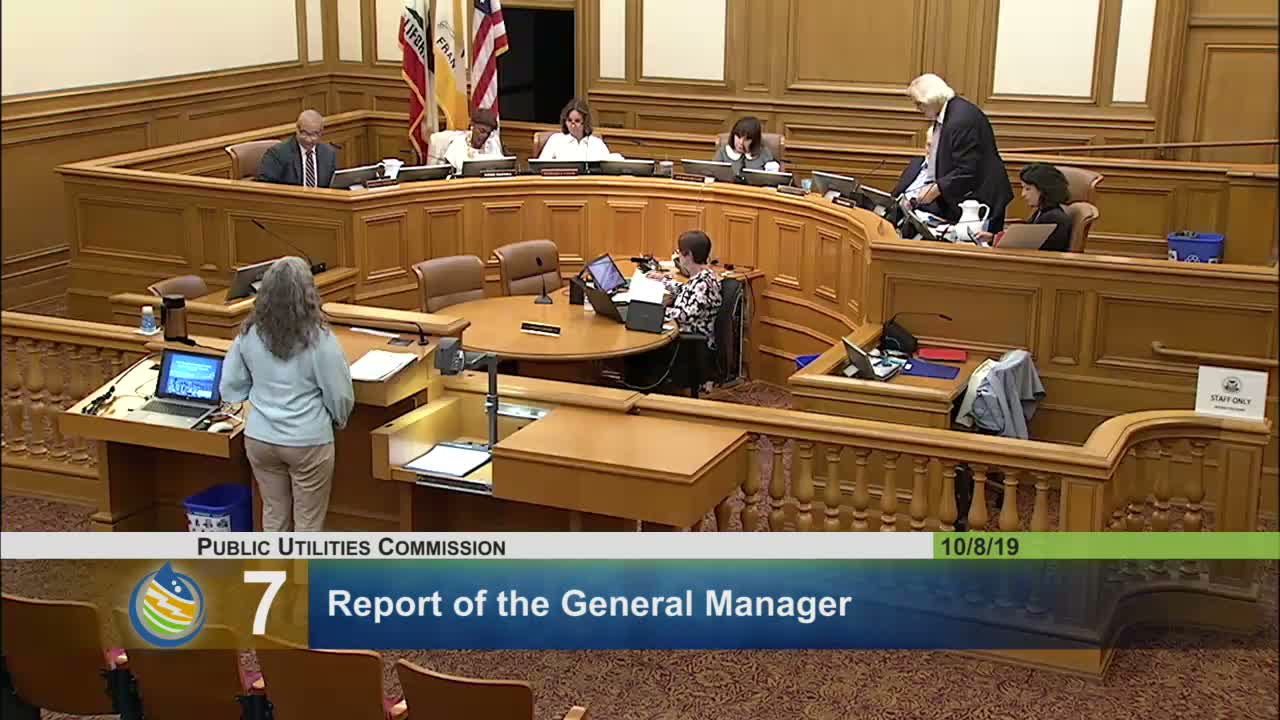
Barbara Hale, assistant general manager for power, presented the city’s publicly disclosed, nonbinding letter of intent to buy PG&E’s electric distribution assets serving San Francisco, a proposal submitted Sept. 6 and informed by a May preliminary report and consultant work.
Hale said the package targets PG&E’s distribution assets in the city — 230 kV to 115 kV transformers and the 115 kV transmission lines that serve San Francisco — as well as streetlights, service yards, rolling stock, inventory and the systems needed to operate local distribution. The preliminary offer values those targeted assets at $2.5 billion in cash and includes a premium designed to facilitate PG&E’s timely emergence from bankruptcy, staff said.
The offer is expressly nonbinding and contingent on comprehensive due diligence, negotiation of purchase documentation and ancillary agreements, and approvals from city bodies and outside regulators, Hale said. It also depends on cooperation with PG&E to allow a full physical inspection of substations, vaults and records. "The offer is conditioned on open the books and the records, the vaults and the substations," the staff presentation said.
Staff cited three principal rationales: reducing San Francisco’s reliance on PG&E for distribution services and the roughly $300 million a year the city pays in distribution fees; advancing the city’s clean‑energy and equity goals; and capturing potential long‑term rate savings for San Franciscans. Hale said the analysis shows acquisition could be “fundamentally sound” against a revenue ceiling based on projected PG&E rates and that the city anticipates future rate savings under a $2.5 billion offer price.
Commissioners pressed staff on practical issues that would shape any transaction. Questions focused on workforce transitions, pensions and wages for PG&E employees who might be recruited to the city utility. Hale said the mayor’s office and general manager have met with labor representatives and that the city intends to recruit willing PG&E employees, examine pension integration and negotiate transition plans. "We value their knowledge, skills, and abilities," she said, describing an intent to build pathways for willing PG&E workers to join city service.
Other questions addressed how PG&E’s interconnection practices and tariff terms have affected local development and affordable housing. Staff noted formal complaints filed with federal regulators about PG&E’s requirements for primary service that, staff contend, have at times imposed oversized equipment and additional costs on small projects. The presentation also discussed how acquisition could let the city close the remaining 20% gap of San Francisco electric consumption not yet served by Hetch Hetchy Power and CleanPowerSF and help reach city renewable goals.
Hale emphasized risks and mitigations: uncertainty about asset condition (hence the conditional due diligence), the challenge of staffing up, and timing risks tied to the speed of the PG&E bankruptcy process and regulatory deadlines. The offer letter envisions using electric sales revenue and a post‑acquisition power enterprise credit structure to fund the transaction rather than drawing on the city’s general fund.
Next steps described by staff include a physical due diligence period, negotiation of transaction documents, and required approvals from the SFPUC, the Board of Supervisors and regulatory authorities. The presentation and Q&A moved the discussion into a closed session later in the meeting for counsel guidance.