Get Full Government Meeting Transcripts, Videos, & Alerts Forever!
Get email alerts on the Water Supply Assessments topic
No spam. Unsubscribe anytime.
SFPUC approves water-supply assessments for five projects amid Bay-Delta flow uncertainty
Summary
The commission approved water-supply assessments for five development projects (including Balboa Reservoir) after adding language endorsing voluntary-agreement negotiations; staff provided three supply scenarios tied to the State Water Board's Bay-Delta plan and warned worst-case retail rationing could reach ~50%.
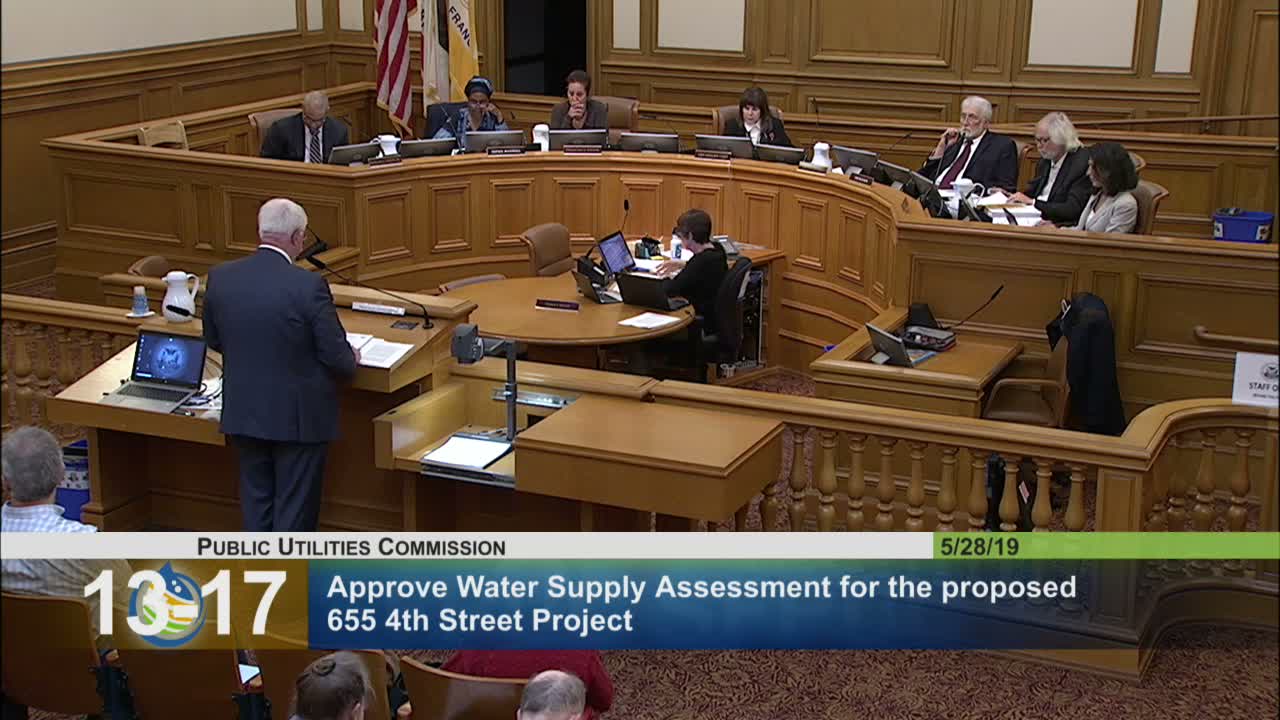
The San Francisco Public Utilities Commission on May 28 approved water-supply assessments (WSAs) for five development proposals, including the Balboa Reservoir project, while adding a formal statement supporting SFPUC participation in voluntary-agreement negotiations with the state.
Steve Ritchie, assistant general manager for water, told commissioners the items present a range of outcomes because of the State Water Resources Control Board's December action on the Bay-Delta plan. "We had to identify three possible scenarios," he said, including (1) the plan as adopted, (2) a voluntary agreement that would supersede the plan, and (3) litigation that sets the plan aside. Ritchie said staff also included an eight-and-a-half-year design-drought sequence for planning purposes.
Under the plan-as-adopted scenario, Ritchie warned, retail rationing could reach up to 50% in the deepest year and a half of the design drought and wholesale rationing "on the order of 65%" if no additional supplies or agreements are secured. He framed the WSAs as informational: the commission must provide planning staff with the range of likely water-availability outcomes so the Planning Department can conduct CEQA review.
Public commenters and environmental advocates urged caution. Peter Dreckmire of the Tuolumne River Trust said the commission's modeling choices matter: he disputed the length and severity of the design drought used by staff and said the Bay-Delta plan's 40% unimpaired-flow objective should guide decisions. Other community speakers asked the PUC to postpone WSAs until state outcomes or the aggregate pipeline of pending projects are clearer.
Commissioners debated timing and metrics. One amendment — added and approved for all five WSAs — restated the commission's intent that any final voluntary agreement must "improve the health of the fisheries and maintain the reliability of its water supply, including a maintenance of level of service goal of no more than 20% system-wide rationing." After adding that language and minor technical revisions staff had prepared, the commission voted separately on items 13–17 and approved each.
Next steps: the WSAs, with the three scenarios and the added whereas language, will accompany the projects to the Planning Department for CEQA; staff said it will continue pursuing diversified supply options (recycling, transfers, desalination and other projects) while the voluntary-agreement negotiations proceed.