Get Full Government Meeting Transcripts, Videos, & Alerts Forever!
Get email alerts on the Public Comment Code Of Conduct topic
No spam. Unsubscribe anytime.
Committee revises public-comment and code-of-conduct rules, emphasizes accessibility
Summary
The policy committee revised the district—280—9s code of conduct and public-comment procedures to add a civility definition, accommodate individuals with disabilities, limit disruptive removals to "substantial" disruptions, and require accessible sign-up options (website and district-clerk phone number).
The Carmel Central School District policy committee spent much of its Aug. 21 meeting updating the code of conduct and public-comment procedures to reflect accessibility concerns and clearer rules for online and in-person participation.
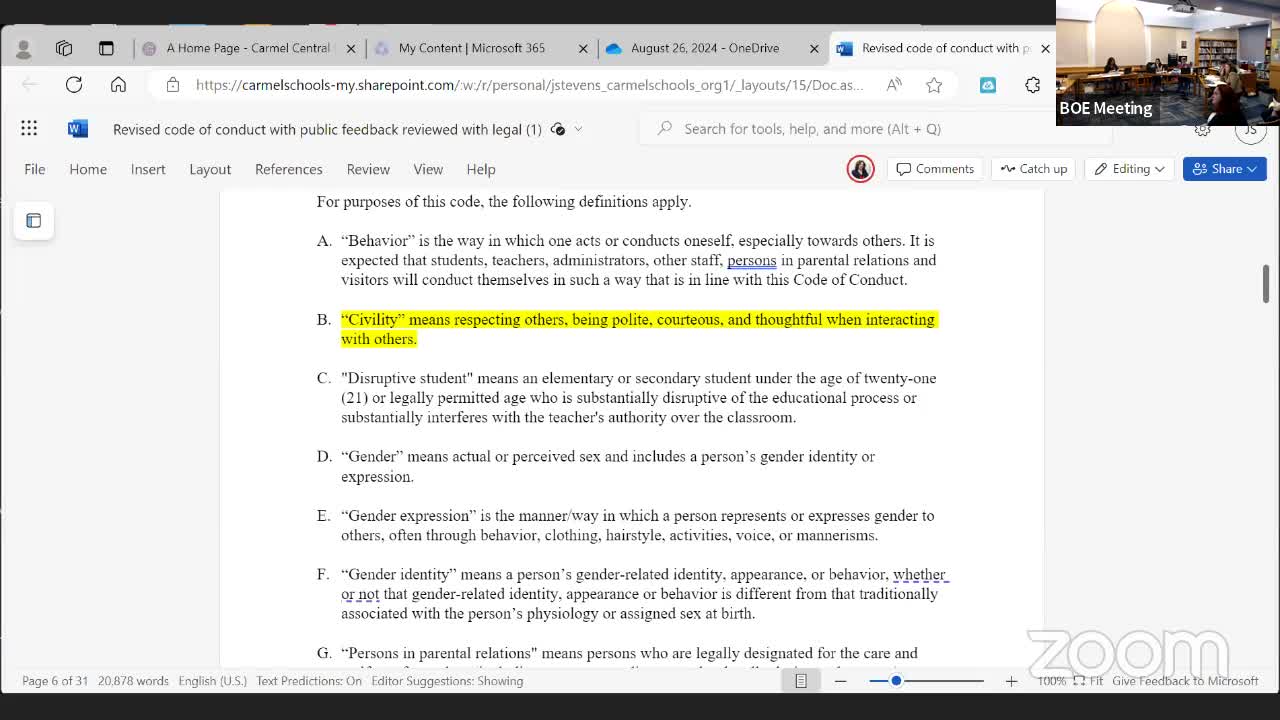
The committee added a definition of civility to the code of conduct that committee members said mirrors classroom instruction: "Civility means respecting others, being polite, courteous, and thoughtful when interacting with others," a member said while presenting the change. The committee agreed to expand the definition to explicitly include speech, gestures, actions and expressions so nonverbal behavior is addressed.
Access and accommodations: Members emphasized that conduct rules must account for people with disabilities. Committee members discussed replacing broad language that would allow removal for a "disruption" with narrower wording that requires a "substantial disruption that prevents the board from efficiently completing its business" before removal is considered. They cited examples such as involuntary vocal tics or a crying infant to explain why the clause should protect people whose behavior is disability-related.
Public-comment structure and sign-ups: The committee formalized a two-session public-comment structure: a 30-minute session at the start of regular board meetings limited to items on that night—280—9s agenda, and a second 30-minute session at the end of the meeting open to any topic. Speakers will be limited to five minutes each and will generally be permitted one opportunity to speak in each session; a speaker who participates in the first session may speak in the second only if time permits. Staff will post the sign-up procedure on the Board of Education page of the district website and include a phone sign-up through the district clerk for people without web access; the committee also discussed printed flyers and a marketing campaign to publicize the changes.
Names and personnel references: The committee discussed restrictions on naming district employees during public comment when the subject implicates personnel matters. Several members said personnel issues must be handled in executive session, but they also asked staff to draft compromise language allowing the public to refer to presenters by name when the reference is directly tied to an agenda presentation (not a personnel complaint).
What happens next: Staff will embed links to referenced policies and compliance-training resources on the website, finalize tracked edits, and post the revised code of conduct and public-comment procedures for readoption at the next board meeting. Committee members said they want visible communications (a banner on the district site and printed materials) to ensure community members understand how to sign up and the limits on public comment.
Quote from the meeting: "All attendants are to be respectful of the Board of Education meeting; any individual in attendance who breaks the code of conduct in any manner may be removed," one member explained while the group revised the removal standard to require a substantial disruption before removal.
Closing: The committee did not take a final vote to adopt these changes at the meeting; staff was directed to finalize language and prepare the item for readoption at the next meeting.