Get Full Government Meeting Transcripts, Videos, & Alerts Forever!
Get email alerts on the Site Selection topic
No spam. Unsubscribe anytime.
Lawrence advisory group reviews 14 downtown candidate sites for transit hub
Summary
Advisory group members in Lawrence reviewed 29 suggested locations and narrowed a list to 14 scorable sites, citing safety, emergency access and private‑ownership constraints; staff asked members to submit ranked feedback by week’s end and will present a revised top‑5 at the next meeting.
Adam, the project facilitator, opened the advisory group meeting by saying the panel had completed the first two planning steps and was now evaluating actual candidate locations within a defined downtown boundary. "We got 146 unique survey participants, and they listed, 310 pins on the map," he told the group, and staff identified 29 suggested locations, of which 14 were judged scorable, 11 were disqualified and four remained pending outreach to private owners.
Why it matters: the group’s choices will guide which 3–5 sites the City Commission considers for concept development and for any Federal Transit Administration (FTA) environmental review. Adam said staff is talking with FTA to learn how many sites the agency will include in NEPA review, but that guidance was not yet finalized.
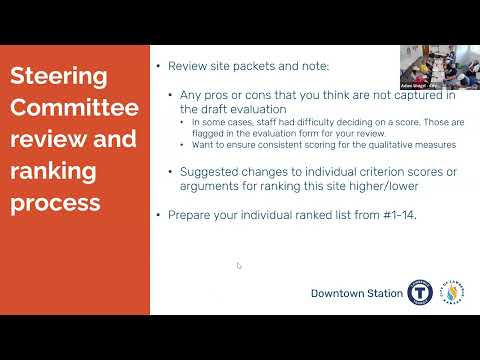
Members split into small groups to review packets and site boards. The meeting combined technical criteria scoring with local knowledge: participants were asked to mark top sites with five stickers (three green stickers were provided for their top three) and to note intangibles not captured by scoring sheets. Adam said staff would use written notes and emailed feedback to revise the rank order and prepare a public synopsis for the next meeting.
Safety and operational constraints shaped much of the discussion. A recurring concern was the current downtown transfer area near the library, where one participant said frequent mid‑block crossings without a signal make it "really scary" and "the maximum waiting to happen." Transit staff and members flagged two candidate locations for significant operational problems: Site 2, adjacent to a fire station, would leave very tight space and require frequent coordination when trucks exit; and Site 19, east of Kentucky across Watson Park, would create routine afternoon traffic backups and would likely require new traffic controls for bus departures.
By contrast, Site 20 (the Seventh Street segment near Watson Park and the pool) drew support for its proximity to services and an existing pedestrian crossing, though staff noted a steep grade outside the sidewalk and warned against encroaching into Watson Park, which is a flood‑hazard area. Participants also discussed privately owned lots (for example Sites 10 and 15); Adam confirmed some owners have indicated willingness to sell, but clarified that willingness is an early, nonbinding indicator and price negotiations would come later.
Staff said they consulted engineer Dustin Smith on crash and design data and reported few crashes on the Seventh Street block under discussion; a recently installed signalized crosswalk was cited as a safety improvement. Adam asked members to email notes and site rankings "ideally by the end of this week" so staff could compile feedback and present a reorganized top‑5 at the next meeting. The group also discussed scheduling; Adam said the meeting date had been moved in the transcript to "the 20 third."
The meeting concluded with an attempted motion to adjourn; several participants voiced 'aye,' but the transcript records uncertainty about whether the adjournment was formally completed. Staff plans to post a public synopsis of the feedback and to continue the site‑selection discussion at the next convening.