Get Full Government Meeting Transcripts, Videos, & Alerts Forever!
Get email alerts on the Bay Delta Flow Policy topic
No spam. Unsubscribe anytime.
SFPUC urges negotiated settlement with state on Bay-Delta flow rules as public testimony splits
Summary
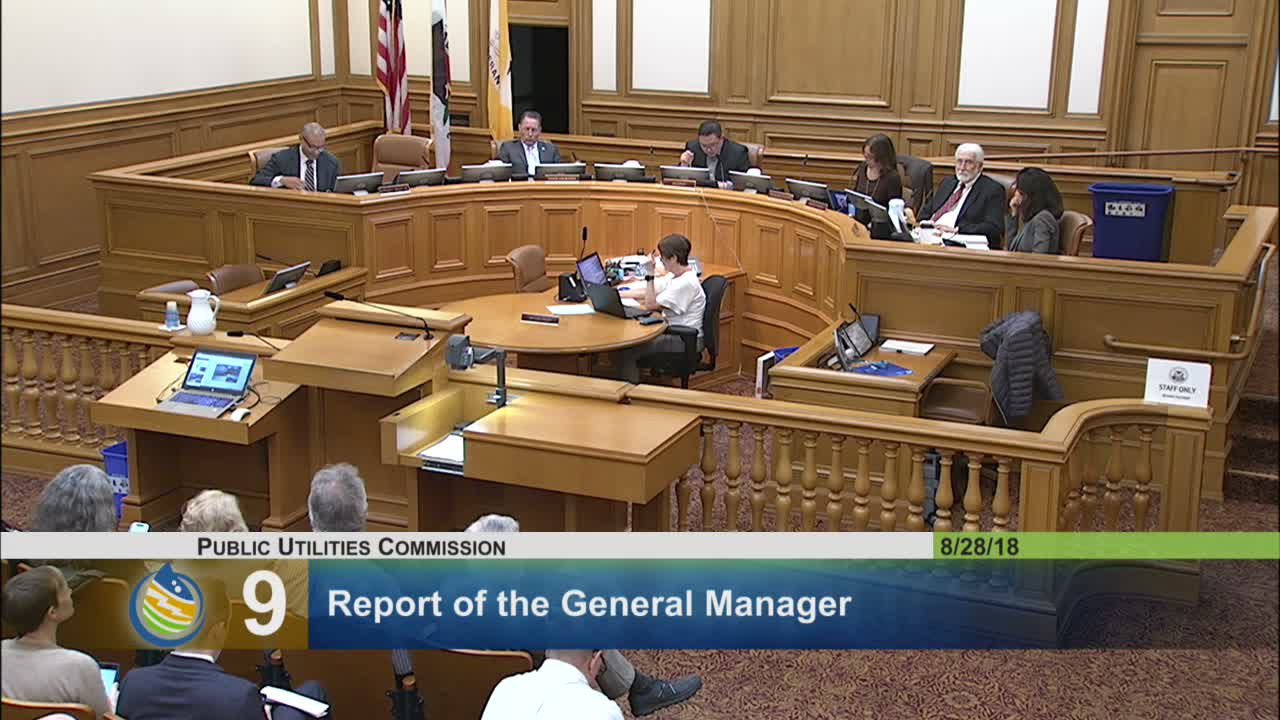
At an Aug. 28 San Francisco Public Utilities Commission meeting, staff outlined an alternative Tuolumne River Management Plan and warned the State Water Resources Control Board's draft Bay-Delta flow proposal could sharply cut local supplies; dozens of public commenters were sharply divided between supporting the PUC's negotiated-settlement approach and backing stronger mandatory flows.
The San Francisco Public Utilities Commission on Aug. 28 pressed for a negotiated settlement with state regulators and warned that the State Water Resources Control Board's draft amendments to the Bay-Delta water quality plan could impose large water-supply impacts while delivering uncertain ecological benefits for the Tuolumne River.
Assistant General Manager for Water Steve Ritchie told commissioners the state's proposal is based on generalized "unimpaired-flow" studies from other river systems rather than on Tuolumne-specific analyses. "Not of the Tuolumne River itself," Ritchie said when asked whether the state's proposed flows were grounded in studies of the Tuolumne. He described the PUC's alternative, which the agency calls the Tuolumne River Management Plan, as a science-based package that pairs targeted, "functional" flows with habitat restoration, gravel augmentation and adaptive monitoring intended to deliver biological benefits with less total water release.
"We're proposing a win-win solution that will offer best results for the Tuolumne River fish and residents," General Manager Harlan Kelly said, framing the PUC approach as one that seeks both habitat improvements and continued reliability for roughly 2.7 million Bay Area customers served by the system.
Wholesale-customer organizations and business groups said the state's flow targets would impose painful rationing and economic costs. Al Mendel, chair of BOSCA (a consortium of 26 wholesale agencies), said the state board's plan could force some service areas to require "as low as 25 gallons per day" per person during droughts, a cut he called "untenable." Multiple business and municipal speakers — including representatives from the San Francisco Chamber of Commerce, the Bay Area Council and Stanford University — urged the commission to support and use the PUC's alternative as the platform for negotiating a voluntary settlement.
Environmental organizations, commercial and recreational fishing groups and many San Francisco residents urged the opposite: support for the State Water Board's plan or stronger flows. "Fish don't swim in hydrology," Nancy Arbuckle, a San Francisco resident, told commissioners, urging them to favor substantive water allocations for fish over non-flow measures alone. Sierra Club and Tuolumne River Trust representatives said decades of habitat-only efforts have not restored salmon populations and argued that substantial flows are necessary to revive runs.
Technical disagreements underpinned much of the dispute. Ritchie and PUC staff said the PUC and its technical partners have developed models and studies specific to the Tuolumne that show targeted flow-plus-habitat measures can raise smolt production efficiently; environmental and fisheries groups countered that broader, higher flow baselines (the State Water Board's staff analysis has cited 40% of unimpaired flow with adaptive bands of 30% to 50%) are the most reliable path to recovery.
Ritchie outlined potential responses if the state imposes large flow requirements: the PUC would have to pursue new regional supplies such as Los Vaqueros expansion, advanced purified (potable reuse) projects or a regional desalination plant, options he said are costly and take years to develop. He noted the PUC is already pursuing conservation and several supply-diversification projects but warned that sudden, large regulatory flow obligations would materially alter service-area planning and could lead to increased rationing or system changes.
The State Water Resources Control Board delayed a vote in recent weeks, opening time for settlement talks that several speakers urged be used. "The delay gives time for parties to reach a voluntary negotiated settlement," Al Mendel said. Ritchie confirmed staff participation in negotiations and said the PUC favors a negotiated solution over litigation, but cautioned that successful settlements must include irrigation districts and state agencies because of complex water-rights agreements dating to the Raker Act and a series of historic contracts that shape how additional flows would be allocated.
What happens next: commissioners said they want more comparative analysis of contested scientific points and the scenario-planning that would show the likely water-supply, cost and operational impacts if a 30%–50% unimpaired-flow requirement were adopted. Ritchie told commissioners his office can produce a concise memo identifying the core factual disagreements and an analysis of mitigation and supply-cost options in the coming weeks. The State Water Board's schedule at the time of the presentation showed reply comments and an all-party meeting in early September and a possible earliest vote in mid-September, but staff said the state had already deferred a vote to allow settlement discussions to continue.
Provenance: The PUC's staff briefing and technical claims are drawn from the presentation and exchanges beginning when Item 10 was introduced and presented to the commission on Aug. 28; the publiccomment record during the Aug. 28 meeting includes 32 speakers across a wide range of positions and is summarized here.
Ending: Commissioners did not take a formal vote on Item 10 during the Aug. 28 meeting; rather, the session served as an extended public hearing and staff briefing and produced requests for additional analysis and a desire among commissioners to continue engagement as settlement talks proceed.