Get Full Government Meeting Transcripts, Videos, & Alerts Forever!
Get email alerts on the Municipal Finance topic
No spam. Unsubscribe anytime.
Evansville council adopts amended finance ordinance amid public outcry over opioid and ARPA grants
Summary
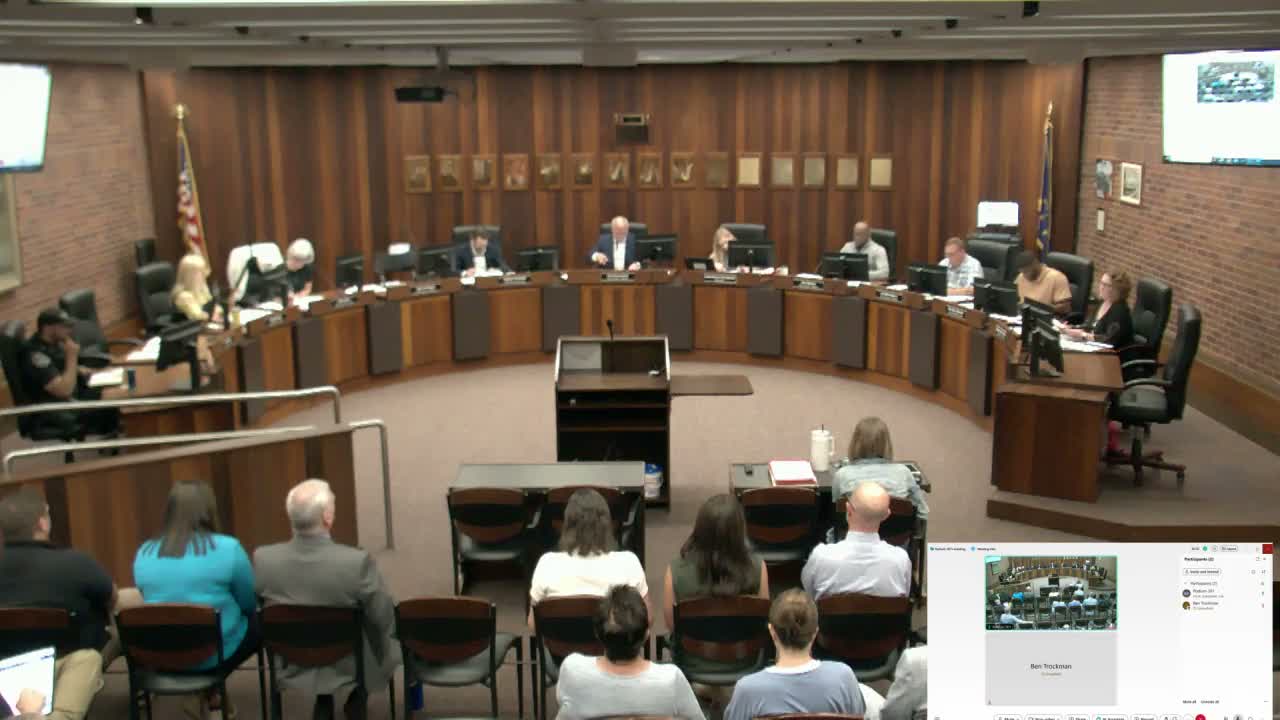
The Evansville Common Council on Sept. 23 approved an amended finance ordinance moving ARPA interest and opioid settlement funds into city accounts for spending, despite public criticism that the award process favored hospitals and law enforcement over grassroots harm‑reduction groups.
The Evansville Common Council voted 7–1 on Sept. 23 to adopt an amended finance ordinance (F‑2024‑11) that transfers and appropriates funds across multiple city accounts, including interest earned on American Rescue Plan Act (ARPA) proceeds and allocations from opioid settlement funds.
City Controller Robert Gunter detailed the ordinance and its amendments, asking the council to approve additional appropriations and inter‑fund transfers. Highlights included $12,300 to cover shortfalls in animal control; a $33,866.89 public‑safety grant for police broken into equipment, services, repairs, uniforms and advertising; and two transfers of $221,000 in ARPA interest that the administration said would be used to buy vehicles for the police and fire departments (the staff estimate was approximately five to six vehicles for each department). Gunter also described a $770,190.70 Community Crossing reimbursement designated for paving, and a $320,000 federal reimbursement to cover construction engineering for the Walnut Street project.
The ordinance also allocates opioid settlement funds: the controller reported $371,826 in unrestricted opioid funds proposed for grants and subsidies and $831,080 in restricted opioid funds available for designated purposes. Mayor Terry (recorded in the meeting transcript as “Stephanie Terrace”) described a vetting process that produced recommendations from a selection committee and said the administration would require grant reporting and prospective grant‑agreement provisions to ensure recipients serve Evansville residents. “We rolled out criteria that went along with the application…we narrowed it down to, I think, about nine organizations,” the mayor said, adding the administration will ask recipients for reporting and require service‑level commitments in contracts.
Public commenters pushed back sharply on those choices. Bert Van Leeken, a nurse practitioner and public‑health professional, urged a different approach to the settlement funds, saying the awards concentrated money with “organizations that only have a select group of the people that this settlement was intended to serve” and that grassroots harm‑reduction providers were excluded. “When I look at those funds combined… I see a majority of the funds here going to organizations that only have a select group of the people that this settlement was intended to serve,” Van Leeken said. Samantha Benty, a board member of Evansville Recovery Alliance (ERA), said her all‑volunteer group supplied thousands of naloxone doses and was not awarded funding; she warned that excluding smaller local providers risks undermining community‑level harm‑reduction efforts.
Mayor Terry responded to concerns by saying the committee reviewed 24 applications and that the administration is open to changes to next year’s process. She said grant agreements would include reporting requirements and could specify the percentage of Evansville residents served by out‑of‑county grantees. “A caveat that we can put in that grant agreement is that they will serve X percent of Evansville residents through their program,” she said.
Council members expressed a mix of views in the debate. Several members praised the administration’s attempt at a more structured process but urged greater transparency and stronger consideration of grassroots providers for future awards. Councilmember Mosby, who voted in favor, asked that the administration prioritize “boots on the ground” groups in upcoming disbursements. Councilmember Johnson said he was not comfortable voting in favor because questions remained and voted no.
After debate and public comment, the council adopted the ordinance by voice vote, recorded as 7 ayes and 1 nay. The ordinance transfers the appropriations into designated line items; awards and contracts will be finalized through subsequent contract and reporting processes handled by the controller’s office and the Board of Public Works.
What happens next: the council’s approval authorizes the appropriations and transfers described in the ordinance; specific grant agreements, contract terms and reporting requirements will be developed by the administration and the controller’s office and will be subject to the city’s contracting and reporting processes.