Get Full Government Meeting Transcripts, Videos, & Alerts Forever!
Get email alerts on the Land Use Zoning topic
No spam. Unsubscribe anytime.
Board of Zoning Appeals denies Garden Quest’s request to expand hands‑on education on residential lot
Summary
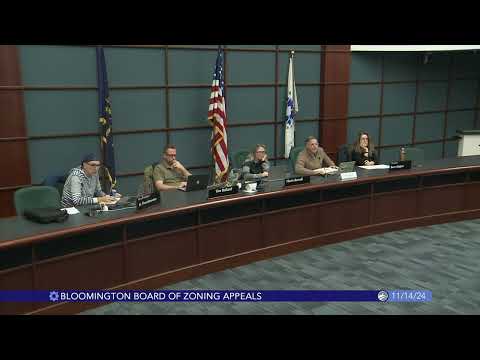
After hours of testimony from the Spears family, neighbors and educators, the Bloomington Board of Zoning Appeals on Nov. 14 denied a conditional‑use request (CUV‑2624) and a variance that would have allowed Garden Quest to run expanded educational programming on a 1.65‑acre R2 property at 2110 East Covenanter Drive.
The Bloomington Board of Zoning Appeals voted unanimously on Nov. 14 to deny a petition from Garden Quest to operate expanded educational programming on a 1.65‑acre residential lot at 2110 East Covenanter Drive.
Jackie Scanlon, the city’s Development Services Manager, told the board the request was for a home‑occupation conditional use with a companion variance to allow more than one nonresident employee. Staff recommended approving a conditional‑use limited to activity inside the dwelling and denying the variance; staff proposed conditions including that the entirety of the home occupation take place within the structure, attendees park on improved surfaces or in the garage, and no more than 15 people be on site for educational programming at one time.
Petitioner Ellie Spear described Garden Quest as an urban‑farm educational program that has hosted interns, school field trips and community workshops. "We are doing this for the community, not for ourselves," she told the board, summarizing her request for both small regular sessions and occasional larger tours. Her husband, Brett Spear, said the family had worked with city staff since 2021 and argued the activity is educational rather than commercial: "We had no idea we were gonna get into this…we had no intention of doing this," he said, describing how community demand evolved into structured programming.
Supporters included teachers, university students and volunteers who said Garden Quest offers hands‑on lessons in composting, beekeeping and food production. Several teachers and school representatives told the board the site has hosted field trips and internship experience that are difficult to replicate in schoolyards. One university student said the partnership supplied practical training she could not get in the classroom.
Neighbors and residents who opposed the request focused on site scale, parking and notice. Several adjacent homeowners said Brooks Drive is a narrow, mostly residential street and expressed concern that even well‑intentioned education programs could increase traffic, degrade neighborhood character or be difficult to enforce. A nearby resident said the petitioners had not sufficiently engaged immediate neighbors before expanding programming and that some backyard changes (driveway, mulch in right of way) raised compliance questions.
Board members centered deliberations on code language and their legal authority. Staff told the board that "noncommercial urban agriculture" is a principal use in the Unified Development Ordinance (UDO) and is not an accessory use to a single‑family dwelling; because the Spears’ lot’s principal use is dwelling single family, the staff said outdoor programming that amounts to a principal noncommercial agricultural use would need a separate policy change through Plan Commission and Common Council. Staff also said the UDO lacks a definition for "employee," and the department interprets volunteers and interns as having the same site impact as employees for the purpose of the employee cap.
After discussion, a motion to approve the conditional use with staff conditions failed on a 1–4 roll‑call vote (Clapper yes; Throckmorton no; Ballard no; Burrell no; Fernandez no). The board then voted to deny the conditional use and the variance, adopting an alternate finding that the petition does not meet the home‑occupation standards. The denial vote was recorded as Throckmorton yes; Ballard yes; Burrell yes; Fernandez yes; Clapper yes.
The board repeatedly noted that making outdoor educational programming lawful on a residential lot would require a legislative change to the UDO and encouraged the petitioners to pursue an amendment with Plan Commission and Common Council. Staff said it is preparing language for a UDO update anticipated in spring 2025 and that petitioners could seek broader relief through that process.
The meeting record shows staff found the indoor home‑occupation program could meet the 11 UDO standards if restricted to interior space, but staff and the board agreed that the BZA does not have authority to reclassify the lot’s principal use or authorize outdoor instruction that would function as a principal noncommercial agricultural use.
Outcome: The board denied the conditional‑use request and the variance for CUV‑2624; the petitioners were advised to pursue a UDO amendment through the council for any outdoor programming beyond what a home occupation allows.