Get Full Government Meeting Transcripts, Videos, & Alerts Forever!
Get email alerts on the Renewable Energy topic
No spam. Unsubscribe anytime.
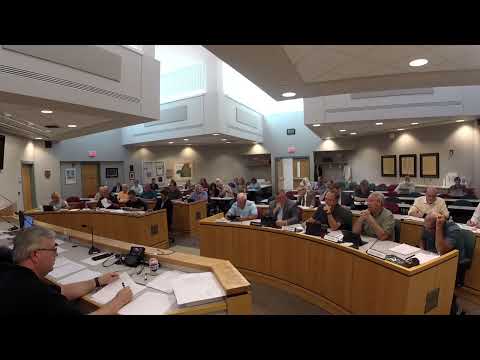
Developers and resident clash over solar special-use permits in Tazewell County
Summary
At a Tazewell County Board meeting, a resident questioned whether state law preempts county siting authority for wind and solar projects while the developer and the projects' attorney urged approval, citing favorable zoning findings and expected local tax revenue.
At a meeting of the Tazewell County Board, public comment and developer presentations focused on three solar special‑use permit applications the board is scheduled to consider under the land‑use portion of its agenda (referred to in the meeting as LU‑24‑23 through 2015).
Tim Barrett, a member of the public, told the board he was concerned that the county may be acting "under duress" if the state has exclusive jurisdiction over the local siting of wind and solar projects. Barrett urged the county to investigate whether the statute referenced in public remarks (spoken in the hearing as "PL1123") is constitutional and warned that allowing an illegal precedent to stand would make it harder to oppose future actions: "If illegal activity is allowed to stand and is not opposed, precedent becomes established, and it is then very hard to stand against."
The attorney for the applicants, Jim Griffin, said the zoning board of appeals (referred to in the record as the CBA/ZBA) made favorable findings for all three Unseeker Sun Solar projects and that the evidence supported conclusions that the proposed uses are compatible with surrounding property and meet the county’s requirements. Griffin argued that the state's siting statute (described in testimony) does not allow denial based on inconsistency with a municipal comprehensive plan and urged the county to respect the landowner's property rights.
Matt Walsh, representing Nexstand and identifying himself as developer and owner of the Unseeker Sun projects, told the board the company sought feedback from the village of Morton but that Morton decided not to endorse the projects. Walsh said the parcel at issue is an approximately 80‑acre site within a much larger undeveloped area and that the projects would deliver "substantial tax revenue" to local communities without adding burdens to schools, libraries, or parks; he also said local businesses and residents could benefit from subscribing to the projects to reduce energy costs.
The developer and attorney emphasized compatibility findings made by the zoning body and urged the board to approve the special‑use permits; the resident speaker urged caution and a legal inquiry into state preemption questions. The board did not take a final vote on the solar items during the portions of the meeting captured in the transcript; the items were described as scheduled for consideration in the land‑use section of the agenda.
The next procedural step is for the board to consider those land‑use items later on the agenda; no formal approval or denial of the solar projects is recorded in the provided transcript segment.