Get Full Government Meeting Transcripts, Videos, & Alerts Forever!
Get email alerts on the Parking topic
No spam. Unsubscribe anytime.
Consultant presents downtown parking assessment; finds ample off‑street capacity but a small constrained zone
Summary
Rick Williams Consulting reported on a downtown parking study showing ~1,200 on‑street and ~1,405 off‑street stalls, peak on‑street occupancy about 45%, and a small area of constrained demand; recommended near‑term actions include formalizing guiding principles, shared‑use agreements and better wayfinding.
At the Oct. 28 meeting the council received a presentation on a comprehensive downtown parking assessment prepared by Rick Williams Consulting.
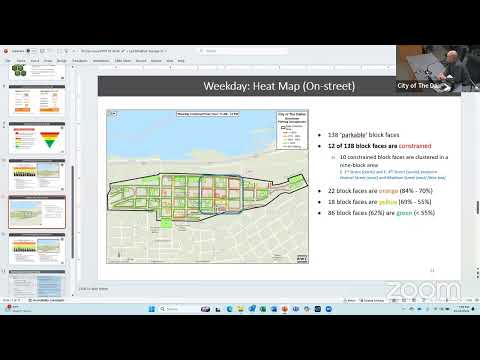
Joshua Chandler (Community Development) introduced the study and consultant Rick Williams, who said the team inventoried every on‑street stall and off‑street lot in the study area and collected hourly occupancy data in May. Williams reported roughly 1,190–1,200 on‑street stalls and about 1,405 off‑street stalls (approximately 2,600 total). He said weekday peak on‑street occupancy occurs at 11 a.m. and is about 45%; Saturday peak occupancy is lower (about 29% at 3 p.m.). The consultant identified a small cluster of block faces that are constrained and produce customer frustration, while the wider downtown remains in the "green" or "orange" bands indicating under‑utilized to efficiently utilized supply.
Key findings: a substantial off‑street supply (hundreds of empty stalls at peak hours) that could absorb growth if shared with customers; about 286 vehicles parked five or more hours on‑street on weekdays (likely employees), and roughly 200 on Saturdays; perceived constraints (people think they can't find parking) account for a large share of complaints; marked improvement could be achieved with targeted management, shared‑use agreements, improved safety/lighting and signage, a parking brand and website, and selective enforcement.
Williams outlined an implementation framework with immediate (0–12 months) actions such as formalizing guiding principles, clarifying the parking management district and shared‑use guidelines, and starting outreach to private lot owners, as well as short‑ and mid‑term options. Councilors asked about the effect of pending developments (Basalt Commons) and whether enforcement or employee parking restrictions could change occupancy patterns; Williams said targeted strategies and data‑driven enforcement could meaningfully improve local constraints without building new garages.
Chandler said the full plan will return this winter for formal adoption and that staff will continue stakeholder outreach.