Get Full Government Meeting Transcripts, Videos, & Alerts Forever!
Get email alerts on the Emerald Ash Borer Identification Management topic
No spam. Unsubscribe anytime.
How to spot and manage emerald ash borer: signs, treatment options and estimated costs
Summary
MDA entomologists outlined EAB biology, the four primary identification methods (S-shaped galleries, larval tail spines, adult beetles, D-shaped exit holes), recommended timing for removals, and described treatment options including insecticides and municipal strategies; homeowners' cost estimate ~ $10 per diameter inch.
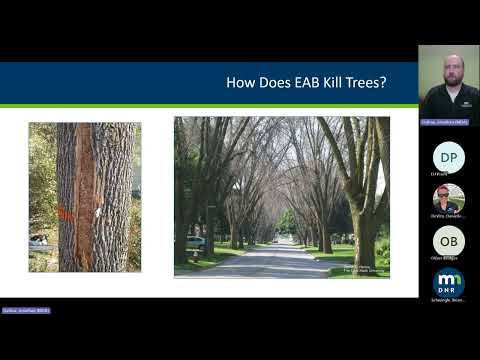
Jonathan Ossos of the Minnesota Department of Agriculture provided a biology-focused briefing on emerald ash borer (EAB) and practical guidance for detecting and managing infestations. He said EAB "infestations always begin in the mid to upper canopy and then work their way down a tree," which is why early canopy inspection is important.
Identification: Ossos listed four reliable identification cues: 1) S-shaped serpentine feeding galleries exposed under removed bark; 2) larvae with two small spine-like projections at the tail end (uropods); 3) the adult beetle — about 1/2 inch long with iridescent green wing covers and a magenta abdomen; 4) distinctive D-shaped exit holes left when adults emerge. He cautioned that some look-alike insects, especially the six-spotted tiger beetle, can be confused with adult EAB and pointed to an MDA handout comparing common misidentifications.
Symptoms and timing: EAB typically produces no visible signs in year 1, woodpecker damage often appears by year 2–3 and major canopy thinning by year 4; average time from initial infestation to tree death is about 5–6 years. Because larvae overwinter under bark, immature stages can be present year-round and wood movements (e.g., firewood) can unknowingly spread EAB.
Management options: Ossos described two main strategies: removals and insecticide treatments. For communities, he recommended conducting an ash inventory and staged removals of poor-condition trees to avoid simultaneous failures. For high-value or large mature trees, properly applied insecticide treatments can preserve trees; these are preventive or therapeutic and must be reapplied per label instructions. He cited emamectin benzoate trunk injections as typically requiring treatment every two years and warned homeowner soil drenches may not be labeled for large trees.
Costs and municipal strategies: On homeowner costs Ossos said, "the average cost for homeowners is kinda close to about $10 a diameter inch." He added that municipalities that invest in injection equipment can reduce per-inch costs (he cited figures around $5–$6 per inch as an example) but noted that re-treatment intervals and local pest pressure affect outcomes.
Best practices and timing: To limit spread, Ossos advised avoiding tree work on ash from May 1 through Sept 30 (the adult flight period). When removals are necessary during active periods, he recommended chipping material on-site, covering loads, or staging removals during the dormant season to allow material destruction before the next flight season.