Lake Zurich board weighs cutting K–8 summer transportation as programs run a $394,000 deficit
Summary
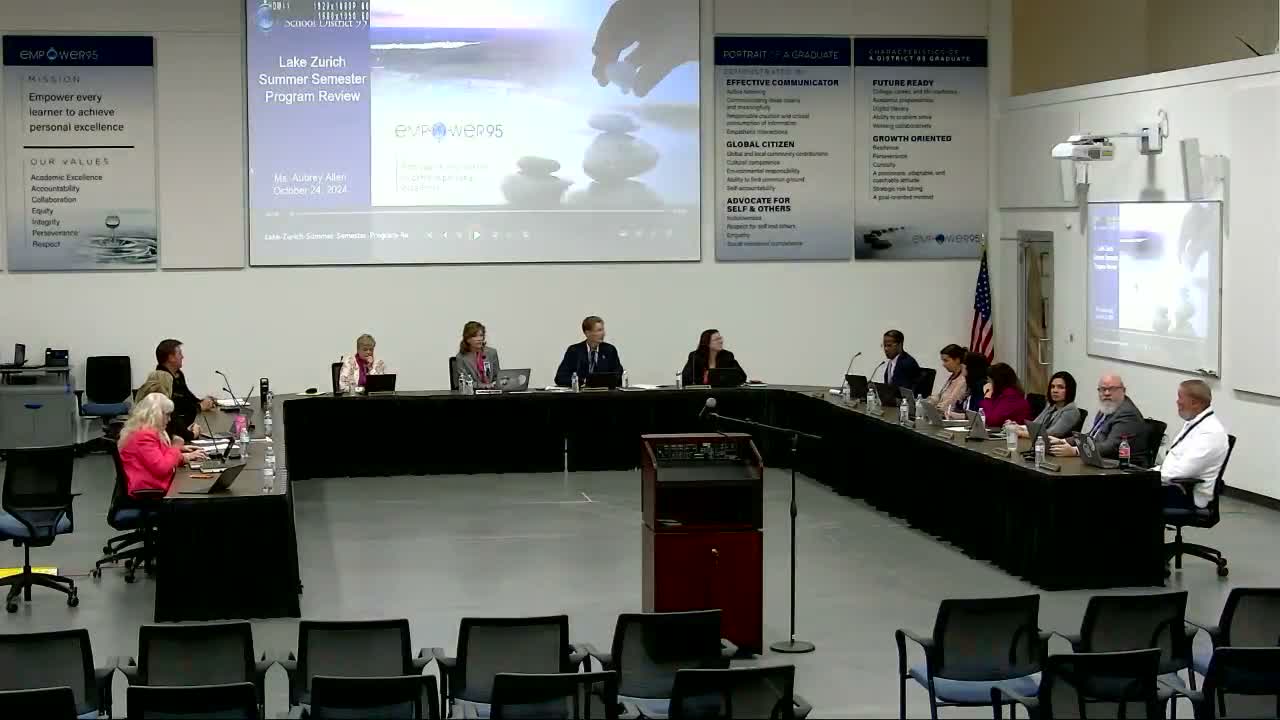
At its Oct. 24 meeting the Lake Zurich CUSD 95 Board discussed options to rein in a $393,963 net expense for the 2024 summer semester, including eliminating district‑provided K–8 transportation, breaking out mandated ESY costs, and seeking benchmarking data; the administration will return with options and more detailed enrollment/cost breakdowns.
The Lake Zurich Community Unit School District 95 Board of Education spent a large portion of its Oct. 24 meeting debating how to address a near-$394,000 net expense for the district’s 2024 summer semester and whether to continue district‑provided transportation for K–8 programs.
"The total net expense reached $393,963," said the presenter for the summer semester review, Mrs. Allen, summarizing finance and enrollment figures and a projection of roughly $395,340 for 2025 if programming remains unchanged. The expense, administrators told the board, was driven largely by providing tuition‑free programming and unexpectedly high contracted transportation costs.
Board members pressed administration about options to reduce costs while protecting access to programs for families who need them most. "I don't think we should cut the transportation at all," said Peter, a board member, who warned that removing district transportation would reduce access for parents who cannot adjust work schedules. Several other trustees echoed that concern, saying transportation barriers would likely reduce participation among students most in need of summer supports.
Trustee Lisa asked whether the district was required to transport all summer participants; administrators clarified that transportation is required only for ESY (Extended School Year) services mandated for students with individualized education plans. Board members repeatedly urged the administration to separate ESY costs from discretionary enrichment offerings in future reports so the board can see mandatory versus optional program expenses.
Board member Natasha and other educators emphasized the academic value of targeted programs such as Bridges, arguing that some students whose scores sit in the mid-percentiles are the ones most likely to benefit and should not be excluded through cost‑cutting moves. Trustee Eileen expressed support for continuing transportation if necessary to preserve program quality and access.
Administration told the board it had surveyed neighboring districts (a small sample of four respondents) on how they fund summer programming and found mixed approaches: some districts cover transportation, others do not, and some use one‑time federal ESSER funds or other grants. Mrs. Allen and staff said they would return with: a clearer breakout of ESY versus discretionary summer costs; multi‑year enrollment and participation trends; per‑student cost analyses; and options showing projected budgets with and without district transportation or with a transportation fee.
The board did not take action on transportation at the meeting. Trustees directed staff to refine financial reporting, pursue additional benchmarking and enrollment trend information, and present concrete budget options at a future meeting so the board can weigh access and equity against cost containment.
What’s next: administration will provide the requested breakdowns and options at a future board meeting for the board’s formal decision on whether to retain, reduce or restructure district‑provided summer transportation.