Get Full Government Meeting Transcripts, Videos, & Alerts Forever!
Get email alerts on the Public Safety topic
No spam. Unsubscribe anytime.
Evansville aims to shore up public safety: raises, new fire station planning and radio replacement
Summary
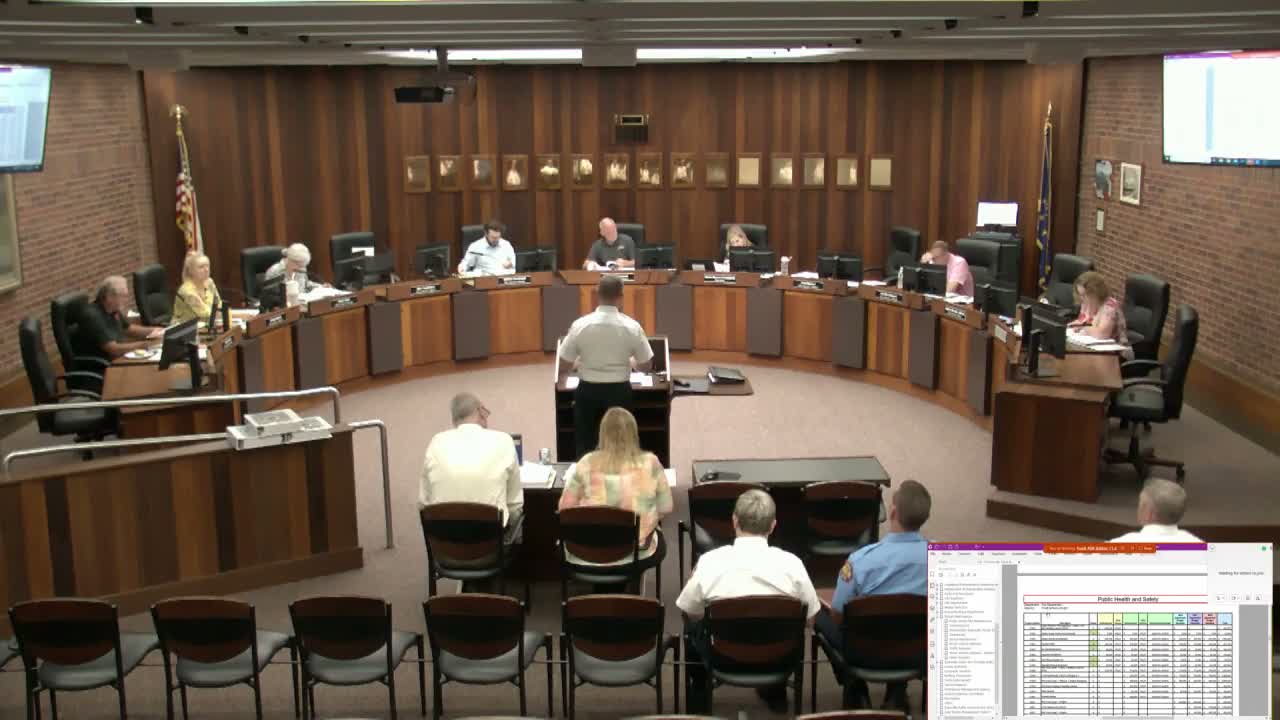
Fire Chief Knight proposed funding for station maintenance and planning funds to site a new fire station to improve response times; he requested portable radios and apparatus funding tied to new OSHA/NFPA requirements. Police leadership requested vehicle and radio replacements, body‑worn camera maintenance and wellness programming.
Evansville city leaders signaled a sizable public‑safety push in the proposed FY2025 budget, asking the council to approve pay increases, new facility planning and equipment replacements intended to improve response times and meet updated federal standards.
Fire Chief Knight described a two‑part approach: addressing deferred maintenance across aging stations and adding targeted coverage. The department requested $300,000 for station maintenance and $375,000 in the CIP to start site planning and initial work on a new fire station in 2025; Chief Knight said the location would be in a general area “between Van and Green River from Lloyd to Washington” to close response‑time gaps. He said the new station would reduce full‑complement response times in affected neighborhoods from about 7½ minutes to about 5½ minutes.
Chief Knight also described regulatory and equipment drivers for cost increases: a forthcoming OSHA rule that will adopt NFPA standards will require more comprehensive equipment testing and compliance. He asked for funds to meet the new hose‑testing regimen and to sustain wellness and specialized medical screening programs for firefighters.
The chief recounted a recent on‑scene failure of radios and used that example to justify a portable‑radio replacement line: “His radio did not work. The commander did not hear him. Central dispatch did not hear him,” he said, describing a near‑miss in a basement fire and asking for funding to buy more reliable, water‑resistant radios and to replace aging apparatus. The department requested additional engines, a heavy rescue and funds for battalion command vehicles, and a budgeted allocation for portable radios and training.
Police leadership also sought continued investment in equipment and personnel wellness. The police CIP includes leased vehicle replacements (the department has hundreds of vehicles in multiple categories), ongoing support for body‑worn camera systems, a Taser refresh and replacement of outdated tactical equipment such as the bomb robot. Police staff cited portable‑radio unit costs (about $8,269 each) and the need to gradually replace older radios to keep the fleet interoperable and water‑resistant.
Both departments told the council they are actively seeking grants and foundation support where feasible to reduce direct city costs, but said that meeting new legal/regulatory standards and addressing long‑deferred maintenance will require city funding to sustain safe operations.
Next steps: council budget deliberations will determine which capital and operating increments become part of the final FY2025 appropriation; department heads were asked to provide any additional detail requested by councilors before final votes.