Get Full Government Meeting Transcripts, Videos, & Alerts Forever!
Get email alerts on the Transmission Line Project topic
No spam. Unsubscribe anytime.
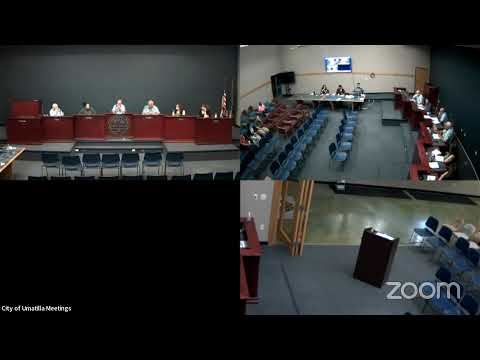
Umatilla hearing draws residents’ opposition to United Electric Cooperative’s proposed 230 kV transmission line
Summary
Dozens of Umatilla residents told the planning commission the proposed ~5.6-mile double-circuit 230 kV line would harm riverfront views, reduce property values, and raise health and wildfire concerns; the applicant asked to leave the written record open under a 7-7-7 timeline and no final vote was taken.
United Electric Cooperative’s proposal for a roughly 5.6-mile, double-circuit 230-kilovolt transmission line drew sustained public opposition at an Aug. 27, 2009 Umatilla Planning Commission hearing, where residents cited visual impacts, declining property values, health anxieties about electromagnetic fields and wildfire risk. The commission did not vote on the application that night; the applicant asked to leave the written record open under a week-by-week '7-7-7' timeline to submit technical responses.
Brandon Sites, Umatilla’s community development director, opened the staff presentation by summarizing the application and procedural record. Sites said staff included the comment letters that arrived before the packet deadline and noted nine additional comment letters arrived the week of the hearing. He described the route in the staff report as starting near the McNary BPA substation and running toward a Port-area substation, and said the applicant had secured easements from most private landowners outside Army Corps property. Sites also flagged that many standard site-review requirements for buildings are “not applicable” to a transmission line and that staff had not yet amended findings to incorporate the late comment letters.
An applicant representative for United Electric Cooperative described the project’s stated purpose as improving system reliability and capacity to serve existing customers and future growth, and to provide a transmission path that UEC said the region needs. The applicant emphasized design choices meant to reduce visual impacts: rather than lattice towers the proposal calls for single-steel monopole structures and a double-circuit configuration to limit the overall right-of-way footprint. The applicant said undergrounding 230-kV transmission across its service territory was not feasible and that preexisting structures could not be reused because they were not designed for the proposed voltage and would require prolonged outages for sensitive loads such as the prison.
Public testimony filled much of the hearing. Speakers who live along Rio Senda, Riverside and nearby riverfront properties said the line would intrude on scenic river views, reduce the sellability and market value of their homes and diminish community livability. Steven Jackie Johnson and others asked why the line could not follow existing corridors to the south or be placed underground. Several commenters raised health and safety concerns related to electromagnetic fields (EMFs) and asked for clearer answers; one resident cited the World Health Organization’s cautious language about long-term effects and another cited a real-estate study they said shows substantial discounts for lots near high-voltage lines.
Residents also raised wildfire and emergency-response concerns. A former fire medic and ex-council member warned that vegetation management and emergency access would be important and noted the speed at which past fires spread in local conditions. Multiple speakers said they did not receive mailed notice in time and asked whether the city’s 100-foot notice radius and mailing procedures were sufficient.
In an emotional exchange, Aaron Johnson, who identified himself as a resident and an Army veteran, said, "This is my home ... I ask that this commission reject this application," and said he feared long-term exposure for his family. Other residents described summer deck use and retirement plans they said would be harmed by a new bank of poles along the riverfront.
In rebuttal the UEC representative acknowledged the comments—"We hear you, we understand"—and addressed several concerns. The applicant said the proposed monopoles and route choices aimed to limit visual impact, that they would implement a wildfire mitigation and vegetation-management program, and that transmission-level undergrounding is not within the co-op’s present technical capabilities. The applicant provided approximate structure setbacks to illustrate visual buffering: roughly 650–1,000 feet in parts north of Rio Senda and near 300 feet near Riverside, and said it would regularly inspect transmission facilities and follow a mitigation plan.
Procedurally, the applicant asked the commission to leave the written record open using a '7-7-7' schedule: seven days for the applicant to submit additional materials, seven days for public rebuttal, and seven days for the applicant to reply. City staff explained that option as an alternative to a formal continuance; under 7-7-7 the record remains closed to new issues but permits targeted technical responses. The transcript does not record a formal commission vote on whether to grant the record-extension request or a final action on the conditional-use application. Earlier in the meeting the commission did record a procedural vote approving minutes from a prior meeting.
What happens next: if the commission agrees to the 7-7-7 approach, UEC would have a week to file supplemental materials responding to the technical questions raised at the hearing; the public would then have a week to respond, and the applicant a final week to reply, after which the record would close and the commission could schedule final deliberations. The applicant also indicated it would submit a written request to leave the record open. The hearing closed with staff noting other city planning business, including forthcoming code updates related to state housing law.
No final permit decision was recorded in the hearing transcript.