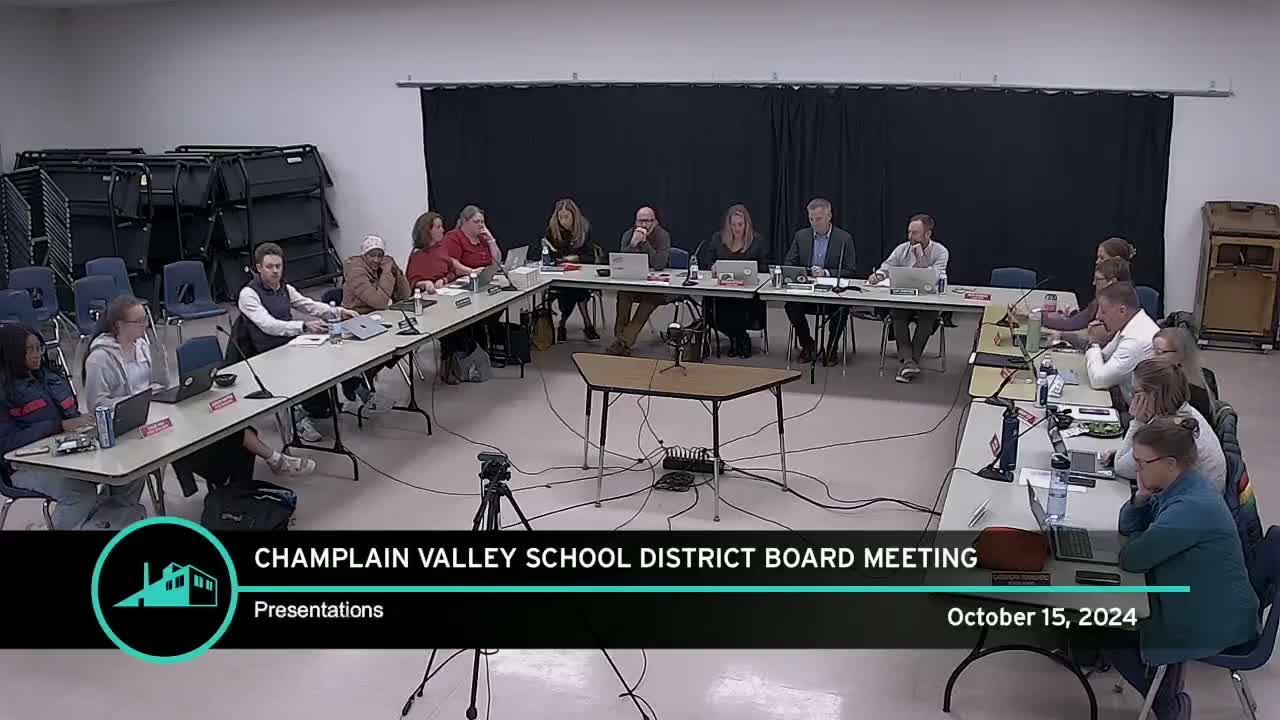
CVSD presents continuous improvement plan focusing on student engagement, math gains and intervention tracking
Loading...
Summary
Sarah Kronum outlined the district’s Continuous Improvement Plan, centered on three goals — safe and healthy schools (measured by engaged‑survey responses), a 5% increase in math proficiency using VTCAP and i‑Ready baselines, and improved academic intervention tracking for students on EST/IEP plans.
Sarah Kronum, presenting the Champlain Valley Unified School District’s Continuous Improvement Plan, told the board the district is centering three goals for the coming cycle: safe and healthy schools, increased math proficiency, and improved academic intervention.
Kronum said the first goal — safe and healthy schools — is anchored to a question on the district’s engaged survey that asks whether students have choice in what they study. She noted the district removed the neutral option on this year’s engaged survey to better capture students’ sense of choice and reported that a substantial number of students had previously selected “neutral,” prompting further inquiry into whether students experience a sense of direction and relevance in their learning.
The second goal focuses on math. Kronum said administration seeks a districtwide 5% increase in the percentage of students proficient in math, disaggregated for subgroups including students on IEPs and students experiencing economic disadvantage. The administration will use VTCAP and i‑Ready as baseline measures and look for trends across multiple measures to identify anomalies and areas for targeted intervention.
The third goal covers academic intervention. Kronum explained the district is tracking both the number of students on formal intervention plans (EST or IEP) and whether students receiving intervention show accelerated growth. She cautioned that cohort‑tracking can be complex because the composition of EST populations changes as students move in and out of plans.
Kronum also reviewed additional data points in an appendix and shared change ideas already in motion. She encouraged the board to consider perception data (students’ sense of direction and belonging) alongside proficiency metrics. The presentation introduced Tyler Cohen as the new communications manager and emphasized a district aim to “de‑jargon” assessment reporting for broader community understanding.
The board and staff discussed how the district will measure progress and whether case‑study approaches can help identify effective practices. Kronum pointed to prior work — for example, targeted phonemic‑awareness coaching tied to the PASA assessment — as an instance where focused professional development coincided with measurable gains.
The indicators committee had reviewed a longer version of the presentation in advance, and committee members praised the condensed presentation and recommended next steps for board review and public reporting. Kronum said the district will continue to triangulate perception data and proficiency measures as it refines reporting for the board and community.
The board did not take action on the CIP text at the meeting; Kronum said additional data and appendices are available for board members who want deeper detail.