Get Full Government Meeting Transcripts, Videos, & Alerts Forever!
Get email alerts on the Transportation topic
No spam. Unsubscribe anytime.
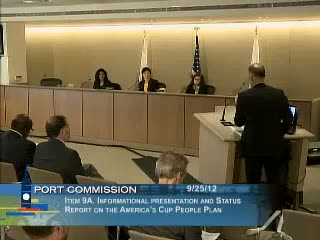
MTA lays out 'people plan' to move crowds for America's Cup and Fleet Week; port highlights ferry expansion
Summary
MTA officials told the Port Commission they expect large crowds for the October America's Cup events and outlined an incident command system, lane treatments on the Embarcadero, augmented transit and satellite parking to reduce car traffic. Port staff said a downtown ferry project was designated for expedited federal support.
The Municipal Transportation Agency detailed an updated "people plan" to the San Francisco Port Commission on the city
side
that aims to move tens of thousands of visitors during the concurrent America's Cup World Series and Fleet Week events in early October. Peter Albert of the MTA said the city is treating the October events as a high-capacity transportation challenge after learning lessons from August.
In a presentation introduced by Diane Oshima of the Port
Planning and Development Division, Albert said the August races drew an estimated 150,000 people overall with a Sunday peak near 40,000 at Marina Green and that transit, bikes and pedestrian planning kept neighborhoods from being overwhelmed. "What we saw in August was tremendously helpful," Albert said, noting robust cooperation from BART, Caltrain, the ferries and Muni.
Why it matters: The plan aims to reduce vehicle congestion, protect emergency access and accommodate large visitor volumes during the America's Cup and the Fleet Week air show. Port and MTA staff said the goal is to make the events safe and repeatable and to use the week
as a testbed for legacy improvements such as permanent wayfinding and streetcar service.
Key elements and timelines
- Incident command: Albert described a cross-agency incident command structure led by Lee Militolo to coordinate Muni service planning, traffic engineers, outreach and operations, with weekly meetings planned ahead of the October events.
- Embarcadero lane treatments: The MTA will close the right-hand northbound parking lane on the Embarcadero north of Washington to provide space for bicyclists and a dedicated emergency-access corridor, "as much a safety issue as anything," Albert said. The change is intended to separate high bike volume from the pedestrian promenade while preserving access for ambulances and fire vehicles.
- Augmented transit and parking: The plan calls for extra service on regional providers (Golden Gate Transit, WETA, Caltrain, BART), historic E Line streetcar runs, limited bus services (the 47 limited), Clipper card promotion, satellite parking hubs (UCSF, USF, Civic Center garages) and partnerships with private shuttles and hotels. Albert said the MTA has produced brochures and wayfinding materials to distribute before events.
- Bicycle and pedestrian management: Temporary wayfinding, bicycle valet and a pilot bicycle wayfinding system with time estimates for rides between key nodes will be deployed; staff emphasized the need for trained personnel to manage heavy pedestrian flows in overflow viewing areas.
Public concerns and operational details
During public comment, resident Sue Hester urged more citywide pedestrian-control staffing in overflow areas (Union Square, Yerba Buena), saying "around Moscone Center last weekend, it was horrible" and calling for increased training for personnel to control pedestrian crossings. Commissioners sought assurances about staffing levels; MTA said the incident command team and weekly staffing coordination are intended to address those gaps.
On maritime and ferry operations, port and MTA staff said the Water Emergency Transit Authority (WETA) is leading an expedited Downtown Ferry Project expected to deliver a draft EIR/EIS early next calendar year; Dan Hodap of Port Planning said components combined could be "in the vicinity of $110,000,000" when accounting for new gates and pier reconstruction. Peter Daly, Deputy Director of Maritime, said the Port and cruise lines have coordinated changes to provisioning schedules and that volunteer docents and ship greeters will help visitors navigate.
Next procedural steps
MTA will continue weekly incident-command coordination, publish transit brochures and finalize wayfinding and lane treatments before the October events; staff said they will conduct a post-October debrief to refine plans for 2013. Commissioners thanked staff for the briefing and indicated ongoing oversight would continue during subsequent meetings and after-action reviews.