Get Full Government Meeting Transcripts, Videos, & Alerts Forever!
Get email alerts on the Oversight topic
No spam. Unsubscribe anytime.
Office of Citizen Complaints review urges clearer standards, more training and tech; budget limits cited
Summary
Deputy Director Eric Baltazar summarized an audit of the Office of Citizen Complaints that recommended clarifying the preponderance standard, expanding interview and fieldwork protocols, strengthening supervision and attorney involvement, and investing in technology and staffing; budget constraints were noted.
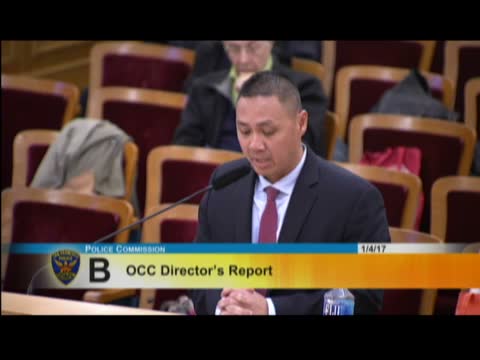
At the Jan. 4 Police Commission meeting Deputy Director Eric Baltazar presented recommendations from an external review (retained reviewer Aaron Zisser) of the Office of Citizen Complaints (OCC), laying out four primary areas for improvement.
Baltazar said the review's recommendations "essentially fall within 4 categories": (1) clarify evidentiary standards and credibility assessment, (2) strengthen investigative planning, interviews and field work, (3) increase supervision and attorney involvement for quality assurance, and (4) improve resources, case assignment practices and technology. He said the OCC will revise procedures to require more officer interviews in certain cases, standardize interview preparation and require electronic filing of investigative materials.
Commissioners asked whether the OCC had already implemented training on credibility and preponderance standards; Baltazar and director-level staff said a credibility-assessment training was conducted in November 2016 and that additional guidance and procedures are being drafted. The OCC presentation listed concrete items such as checklists for intake, requiring interviews of involved officers unless waived by a deputy director, and routine QA reviews by supervisors.
Budget realities were a central point of the discussion. Director Hicks told the commission that mayoral budget instructions constrained new net staffing and asked departments to propose cuts; the OCC has about $350,000 in discretionary funds and an estimated $150,000 to $300,000 in needs flagged for upcoming budget years to support mandated auditing and enhanced technology. "These are challenges," she said, adding that some recommendations are achievable without added staff but others will require engagement with the mayor's budget staff.
Commissioners also asked about the OCC's use of body-worn camera footage. Baltazar said OCC investigators are requesting and reviewing body-worn footage as part of active investigations and that while no OCC investigation had concluded solely on that footage yet, staff expect such evidence to aid credibility assessments.
Public commenters during the meeting sharply criticized the OCC as ineffective; advocates called for more sustained findings of biased policing and for the commission to pursue further oversight. OCC staff and commissioners responded publicly to those criticisms during the comment period and noted work underway to implement the review's recommendations.
The commission did not vote on staffing or budget changes at this meeting; staff said they would pursue policy and budget follow-ups with the mayor's office and return with implementation details where required.