Get Full Government Meeting Transcripts, Videos, & Alerts Forever!
Get email alerts on the Zoning Site Coverage topic
No spam. Unsubscribe anytime.
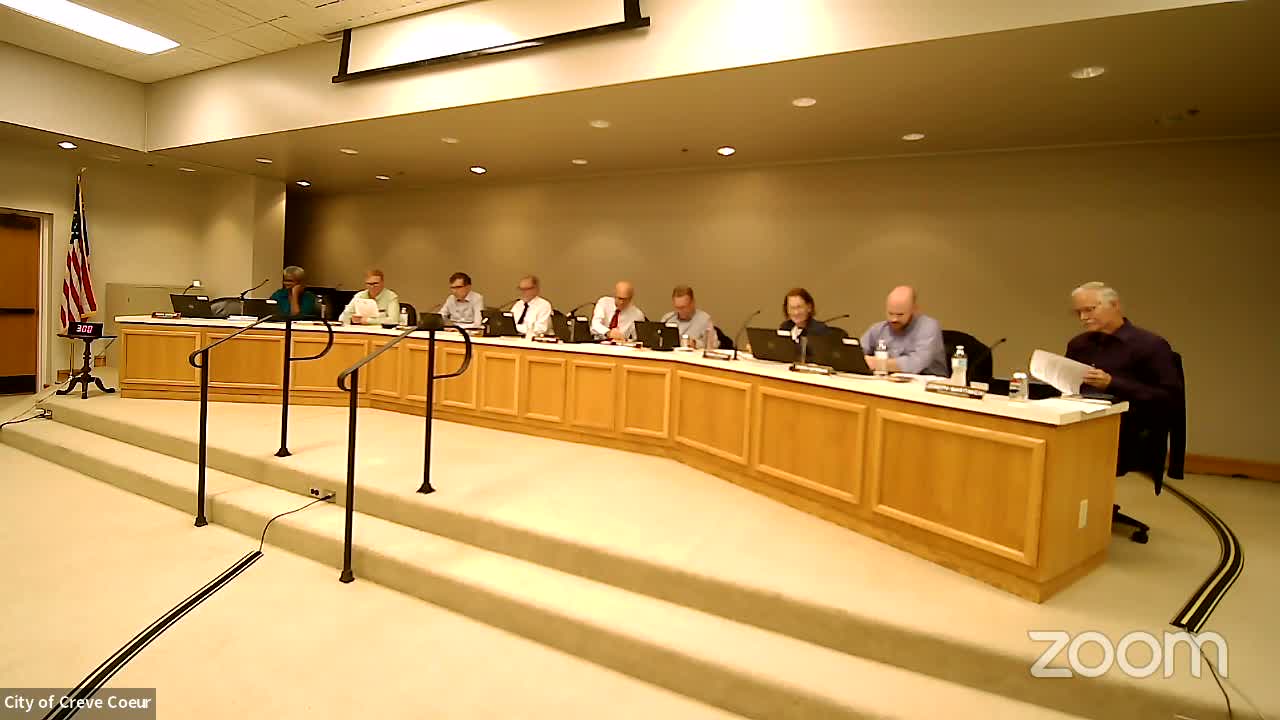
Creve Coeur council hears first reading of zoning change to let membership organizations expand; stormwater concerns raised
Summary
On first reading, council considered Bill 6129 to allow certain membership organizations on 3-acre sites up to 50% site coverage; staff said pools and outdoor recreation decks would be excluded from the calculation. Council members and residents raised stormwater, buffering and design concerns; the measure returns for final consideration.
The Creve Coeur City Council heard the first reading of Bill 6129, a zoning text amendment that would increase permitted site coverage for several membership and recreational uses from the existing residential standard (25%) up to 50% for qualifying sites of at least three acres.
Jason Jaggi, director of community involvement, presented background and examples, naming existing local uses such as the Creve Coeur Racquet Club, Alex Lodge and the Wednesday Club. Jaggi said the text change is intended to mirror prior exceptions granted to religious institutions and schools, and that pools, pool decks, patios and outdoor recreation courts would be excluded from the 50% calculation.
Several council members pressed staff on stormwater and impervious-surface impacts. Council member Donna Spence and another member said Metropolitan St. Louis Sewer District (MSD) requirements would still apply and could require detention or other measures if runoff increased. One council member said the city’s long-term objective should be to reduce impervious area where possible and asked for ‘‘compelling reasons’’ to increase it; another said the 50% cap is a ceiling, not an automatic allowance, and variances would still require a high hardship standard.
Members of the public spoke. James Villanford said changing a footprint requires reevaluating buffering because what was once adequate may no longer be. Todd Scribe, an Elks board member, said the Elks support the amendment to allow façade updates and modest additions; he said the Elks property is just over six acres and can provide stormwater retention. Applicant representatives said their current coverage runs slightly over the 25% standard (around 26–27%), and the amendment would avoid frequent variance requests.
Council discussion included suggestions to encourage permeable surfaces and BMPs (best management practices) where feasible. Staff and council agreed to return the item for a subsequent meeting for final vote.
Next steps: Bill 6129 will proceed to a second reading and a future vote, with staff to provide additional information on stormwater mitigation and how MSD requirements interact with any local code changes.