Get Full Government Meeting Transcripts, Videos, & Alerts Forever!
Get email alerts on the Public Safety topic
No spam. Unsubscribe anytime.
SFPD activates Everbridge alert system; homicide unit outlines scene-response protocols
Summary
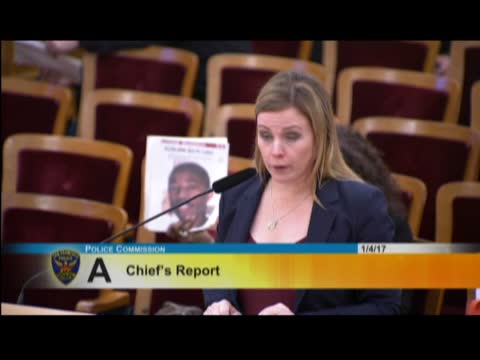
At the San Francisco Police Commission meeting Jan. 4, 2017, Capt. Alexa O'Brien said the SFPD went live with Everbridge to notify command staff and partner investigators simultaneously in officer-involved-shooting events and reviewed homicide scene and decedent-removal protocols and year-to-date clearance figures.
The San Francisco Police Commission on Jan. 4 heard that the Police Department has gone live with a mass-notification system intended to speed and standardize responses to officer-involved shootings and other critical incidents.
Capt. Alexa O'Brien, captain of the Major Crimes Unit, told commissioners the department implemented Everbridge, a telephonic and electronic alert system, to notify approximately 65 recipients at once by phone, text and email. "We have now moved to what's called a modern critical communications telephonic program called Everbridge," she said, adding the system replaces a previously manual process of calling down a long list of contacts.
O'Brien described how the system is expected to reduce lag time and the problem of staggered arrivals at scenes: Everbridge blasts an initial message to all listed recipients and repeats notifications until a response is received. She said the department loaded contact information for command staff, District Attorney investigators and the Department Operations Center into the system and completed a test run ahead of going live.
The captain also reviewed homicide-response protocols, saying patrol secures scenes initially, homicide investigators then determine scene perimeters and CSI processes evidence before a collective "walk-through" with the DA's investigators and other partners. O'Brien noted the Medical Examiner is responsible for removal of decedents and follows state policies aimed at avoiding prolonged public exposure of bodies.
Commissioners pressed for clarification about when District Attorney investigators and others are physically present and how the department selects numbers for Everbridge. O'Brien said the DA's office provides an on-call phone sheet and the department worked with DA investigators to populate Everbridge contact lists so that "virtually every district attorney investigator will receive the notification." The commission also discussed practical contingencies; O'Brien said homicide teams are restricted and on-call 24/7 with backup members to ensure timely on-scene coverage.
O'Brien put the department's homicide-year statistics in context. She said the department recorded 58 homicides for the year and had arrests in 31 of those cases; she described how federal Uniform Crime Reporting rules can make annual clearance percentages appear higher when arrests for prior-year homicides are included in the same reporting period. "So in addition to the 31 people, we have more people that we've arrested this year," she said, explaining the distinction between in-year case closures and UCR reporting conventions.
The captain said improved clearance work has been aided by expanded digital evidence and rapid bulletins to officers. Commissioners and staff agreed to continue refining notification and coordination protocols with the DA and other partners.
The commission did not take formal action on investigative policy changes in this session; O'Brien said more detailed presentations on notifications and Everbridge would be scheduled with other staff.