Get Full Government Meeting Transcripts, Videos, & Alerts Forever!
Get email alerts on the Use Of Force Policy topic
No spam. Unsubscribe anytime.
Police Commission defends ban on shooting at moving vehicles as public debate intensifies
Summary
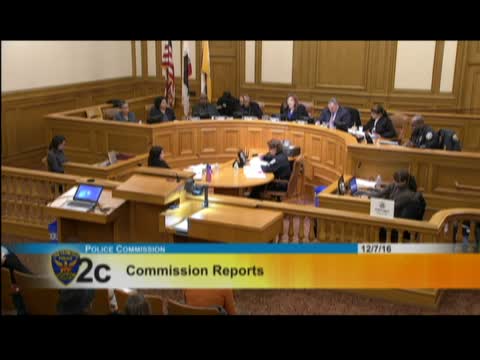
At its Dec. 7 meeting the San Francisco Police Commission and members of the public pressed to implement an updated use-of-force policy that would bar shooting at moving vehicles, while staff and labor negotiators said training agreements are advancing and some details remain to be settled.
The San Francisco Police Commission on Dec. 7 reiterated its support for a proposed update to the department—s use-of-force policy that would restrict officers from firing at moving vehicles, amid fierce public comment and a pushback campaign by the Police Officers Association.
Commission President Loftus said the change is intended to reduce harm while preserving officers— ability to use judgment in exceptional circumstances: "When we say we're attempting to save lives, we mean it," she said, and emphasized the commission—s aim to protect "officers, members of the public, and community members." The commission repeatedly cited the U.S. Department of Justice recommendations and local statistics on officer-involved shootings as context for the revision.
Several commissioners described the proposed restriction as narrowly targeted, not an absolute ban. Commissioner Mazuko said the commission has "unanimously voted that shooting at moving vehicles unless they're shooting at you ... in most circumstances, is not permissible," and argued the policy leaves room for limited exceptions tied to immediate danger.
Public commenters across the political spectrum urged the commission to implement the prohibition promptly. Supervisor Malia Cohen told the panel the Board of Supervisors adopted a resolution supporting the commission—s use-of-force policy and said the endorsement was unanimous. Family members of people killed in past shootings urged the commission not to delay; Shannon Altamirano, a friend of a woman killed by gunfire in 1998, said the POA—s public advertising about the policy was "extremely disturbing" and accused the association of spreading misleading information about historical cases.
City negotiators and the Department of Human Resources reported a tentative agreement with the POA on training that would accompany any policy changes. A DHR representative said the city had reached tentative bargain agreements on several elements of training and that additional non-mandatory topics would be discussed with counsel in closed session.
Commissioners and staff repeatedly noted legal and procedural limits on immediate action. President Loftus said some items must be posted with adequate public notice before a final vote and advised that further detailed discussion would be returned to the commission at a subsequent meeting.
The next formal step the commission flagged is to bring the remaining negotiation details and the agreed training plan back for review. In the meantime commissioners urged continued public engagement and outreach to explain the policy and training timeline.