Get Full Government Meeting Transcripts, Videos, & Alerts Forever!
Get email alerts on the Rate Adoption 2018 topic
No spam. Unsubscribe anytime.
SFPUC adopts four‑year water and wastewater rates and new capacity charges starting July 1, 2018
Summary
After public hearings and review by the Rate Fairness Board, the SFPUC approved a four‑year schedule of retail water and wastewater rates, a new wastewater fixed charge and increased water capacity charges; staff said capital financing, not operations, explains most of the increase and the commission found mailed protests did not constitute a majority under Prop 218.
The San Francisco Public Utilities Commission on April 10 adopted a four‑year schedule of retail water and wastewater rates and revisions to water and wastewater capacity charges to take effect with meter readings on or after July 1, 2018.
Eric Sandler, SFPUC assistant general manager and CFO, said the rate package is grounded in a charter‑required independent cost‑of‑service study and must comply with Proposition 218 procedural rules on notice and protest. Sandler told the commission that roughly 80 percent of the four‑year revenue increase is driven by capital costs and debt service for projects in the agency’s 10‑year capital plan and that staff revised sales volume assumptions using meter‑level data and a conservative 0.5% annual reduction in water sales.
Key design changes include a new fixed charge for wastewater (recovering about 22.6% of the wastewater revenue requirement over four years), retention of existing residential tier breakpoints (4 CCF single‑family, 3 CCF multifamily), consolidation of many small commercial volumetric rates into a single commercial rate, and capacity charge increases (wastewater ≈+4%, water ≈+35%) driven by recent capital investments.
Sandler estimated the average single‑family combined water and wastewater bill would rise about $10 per month each year under the four‑year package (roughly an 8.4% annual increase for a typical household). He also described a temporary drought surcharge mechanism that could be triggered only by a commission declaration of a supply shortage, with finance staff calculating projected revenue loss and a surcharge capped proportionally (stage 1 cap described as 10%).
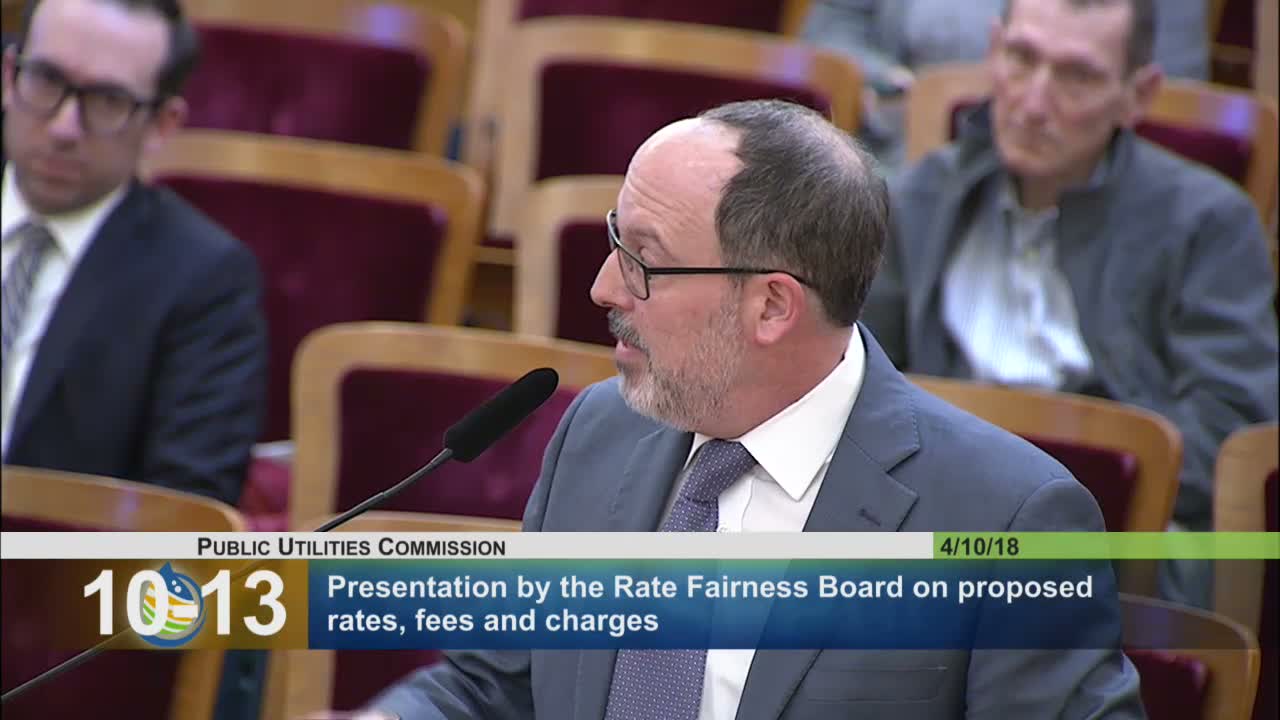
Todd Elmer, chief communications officer, reviewed the outreach program: roughly 247,000 mailed notices, translated materials, community presentations, a public rate calculator and online resources, plus about 700,000 social media impressions and paid op‑eds in community papers. The Rate Fairness Board, represented by Chair Howard Ash, recommended approval and urged stronger enrollment and funding for the low‑income Community Assistance Program (CAP).
Public commenters were split. Shakira Simley of the Southeast Community Facility Commission submitted a resolution supporting the rates for projects and benefits to Bayview; several commenters including Ted Lowenburg and Tracy Thompson protested the increases as unaffordable. Eileen Bogan urged renegotiation of a master water sales agreement and criticized the use of blended groundwater.
The commission read the Prop 218 protest rules and reported 190 mailed protests plus four hand‑delivered protests out of approximately 167,738 affected customers — not a majority — which allowed the commission to proceed. Commissioner Moran moved adoption of the water rate schedule and the commission approved it by voice vote; subsequent motions adopting the wastewater rate schedule and revised capacity charges also passed by voice vote.
The actions fund capital investments the commission and its advisers say are needed to maintain system reliability and meet seismic and regulatory requirements, while several commissioners and members of the Rate Fairness Board flagged affordability and urged more CAP outreach and enrollment.