Get Full Government Meeting Transcripts, Videos, & Alerts Forever!
Get email alerts on the Rates And Affordability topic
No spam. Unsubscribe anytime.
SFPUC outlines 4-year rate package, affordability analysis and proposed changes to shutoff fees
Summary
CFO Eric Sandler presented a proposed four-year rate package starting July 1 that staff say requires roughly 7.6% annual revenue increases; affordability analysis shows about 13% of single-family direct-bill households are 'water cost-burdened' (>2.5% income) and staff proposed retaining the 48-hour posting fee while eliminating separate shutoff and turn-on fees and pursuing CAP enrollment improvements.
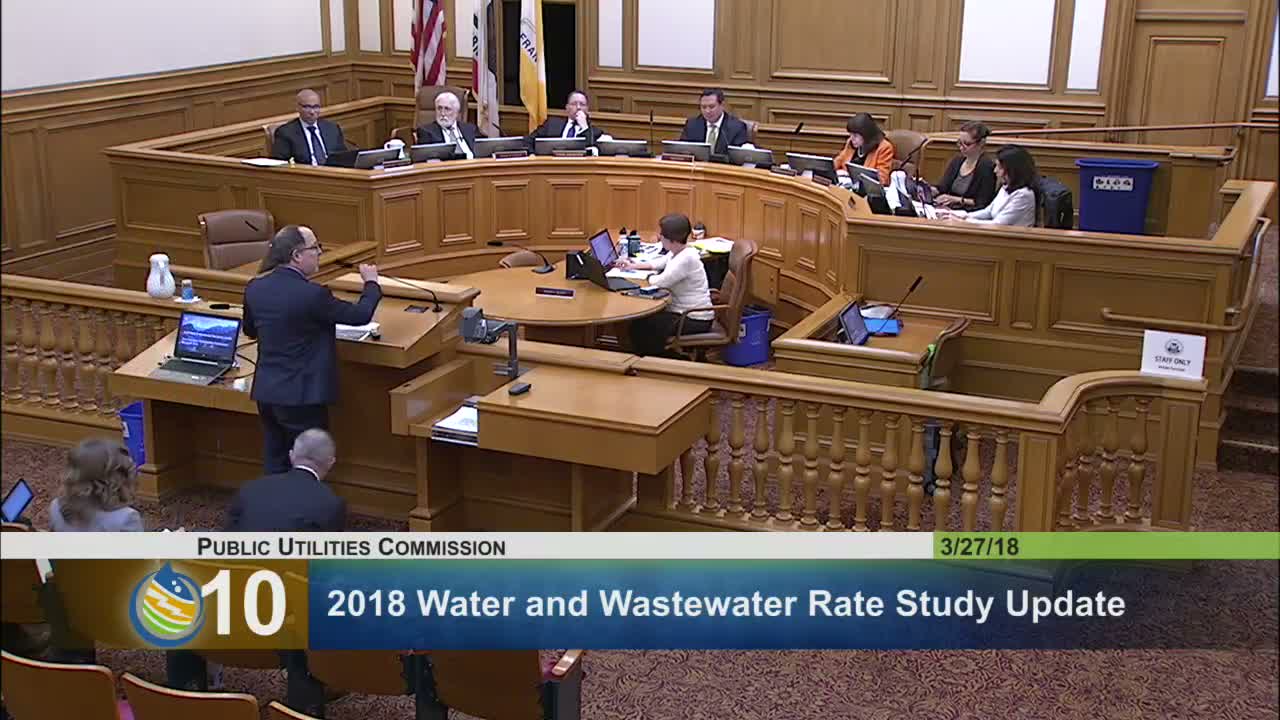
Eric Sandler, the SFPUC chief financial officer, told the commission March 27 that staff will present a four-year rate package on April 10 that begins July 1, 2018. The package reflects a revenue adjustment estimated at about 7.6 percent per year for the water and wastewater enterprises, with roughly 80 percent of the additional revenue targeted to capital investment and debt service.
Sandler summarized proposed structural changes: a small, fixed monthly sewer charge phased in over four years (to mitigate impacts on low-volume users); preservation of the current share of water revenues collected via fixed charges (about 13.9 percent); incremental adjustments to tier breakpoints and a phased compression of tiers over time; and a temporary drought surcharge that would be triggered only by a commission-declared shortage allocation under the Urban Water Management Plan.
On bills and customer impact, staff said a typical single-family combined water-and-sewer bill (5.3 units) is about $108 per month now and the proposed four-year package would raise the bill by roughly $10 each year, moving the average toward approximately $116 monthly in the package’s first year of change.
Simone Hudson (community benefits group) presented the agency’s affordability analysis and outreach plans. Using American Community Survey data, staff estimated about 26,000 single-family direct-bill households are eligible for the Customer Assistance Program (CAP) under the 200 percent federal poverty-line threshold (about 18 percent of direct-bill accounts). Staff also identified approximately 13 percent of single-family accounts — about 19,000 households — as ‘‘water cost-burdened’’ because they pay more than 2.5 percent of household income for combined water and sewer service; the majority of those households are below 200 percent of the federal poverty level. Hudson said staff will focus on streamlined CAP enrollment, verification partnerships with the Human Services Agency, targeted outreach in high-burden neighborhoods and conservation measures tied to assistance.
John Scarpulla (policy and government affairs) walked through shutoff and fee operational data. In FY2016-17 the SFPUC issued roughly 2,000,000 bills to about 175,000 customers; about 60,224 bills were unpaid at day 45 and staff posted roughly 9,600 48-hour notices at day 60. Posting carries a $55 fee; after posting, 88 percent paid before potential shutoff. Last year the SFPUC performed about 1,189 shutoffs (not necessarily unique customers). Scarpulla said staff propose retaining the 48-hour posting fee (with a likely modest reduction) while eliminating the separate shutoff and turn-on $55 fees to reduce burden on struggling households; staff recommended monitoring for unintended consequences if fees are removed and bringing a package of miscellaneous-fee proposals to the commission on May 8.
Commissioners and public commenters discussed CAP enrollment barriers and data gaps linking shutoff accounts to demographic information. Krista Brown of the Financial Justice Project said her office strongly supports eliminating the shutoff and turn-on fees and urged tighter cooperation with the Human Services Agency to leverage verification capacity and improve CAP outreach. Several commissioners asked staff to produce cost estimates for expanded CAP enrollment and to refine comparative shutoff metrics as a percentage of affected households for apples-to-apples comparisons with other cities.
Staff indicated they will return with the formal rate package April 10 and a miscellaneous-fee item on May 8.