Get Full Government Meeting Transcripts, Videos, & Alerts Forever!
Get email alerts on the Traffic Safety topic
No spam. Unsubscribe anytime.
Police commission backs Vision Zero and automated speed-enforcement resolution
Summary
The commission voted to adopt a resolution supporting Vision Zero and advocating automated speed enforcement to reduce severe traffic injuries and deaths; Walk SF's Nicole Ferrara outlined how targeted speed cameras would operate, privacy safeguards and equity provisions, and commissioners asked questions about site selection and revenue impacts.
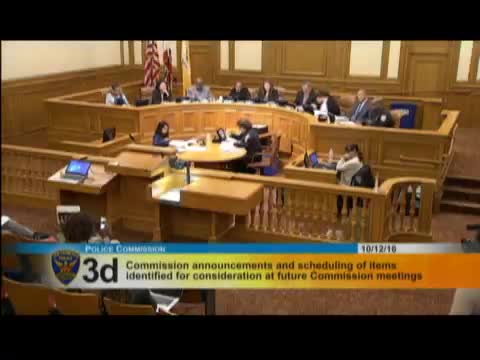
The Police Commission on Oct. 12 voted to adopt a resolution expressing support for the city's Vision Zero goals and for state authorization of automated speed-enforcement cameras.
Nicole Ferrara of Walk San Francisco presented the proposal and told the commission that automated speed enforcement uses cameras to photograph license plates of vehicles exceeding a set threshold (likely between 6 and 10 mph over the limit), issue civil citations rather than criminal charges, and avoid capturing faces to limit privacy intrusions. Ferrara said legislation would be needed at the state level for San Francisco to operate citywide automated speed enforcement.
Commissioners pressed on privacy, equity and revenue concerns. Commissioner De Jesus stressed that some cities have used camera programs as revenue generators and asked how San Francisco would prevent disproportionate impacts on low-income communities. Ferrara said the legislation and local implementation plan are being designed to limit repeat fines by placing time limits so a driver cannot receive multiple violations in a short period, and to allow community-service or other alternatives for low-income residents.
Commissioner Wong asked how camera sites would be selected; Ferrara said the MTA and Department of Public Health are working on a methodology that prioritizes high-injury corridors and includes an equity component and community process prior to activation. After a public comment period, a motion to adopt the resolution passed on voice vote.
What happens next: the resolution urges state authorization and directs local agencies to develop implementation and community-engagement plans; further legislative drafting and public processes will follow.