Get Full Government Meeting Transcripts, Videos, & Alerts Forever!
Get email alerts on the Budget Finance topic
No spam. Unsubscribe anytime.
SFPUC adopts biennial budgets, authorizes multi‑year borrowing and signals average 8% water/sewer increases
Summary
The San Francisco Public Utilities Commission approved biennial operating and capital budgets, a 10‑year capital plan and financial plan that include bond authorizations and forecast average combined water and sewer bill increases of about 8% annually over the next four years.
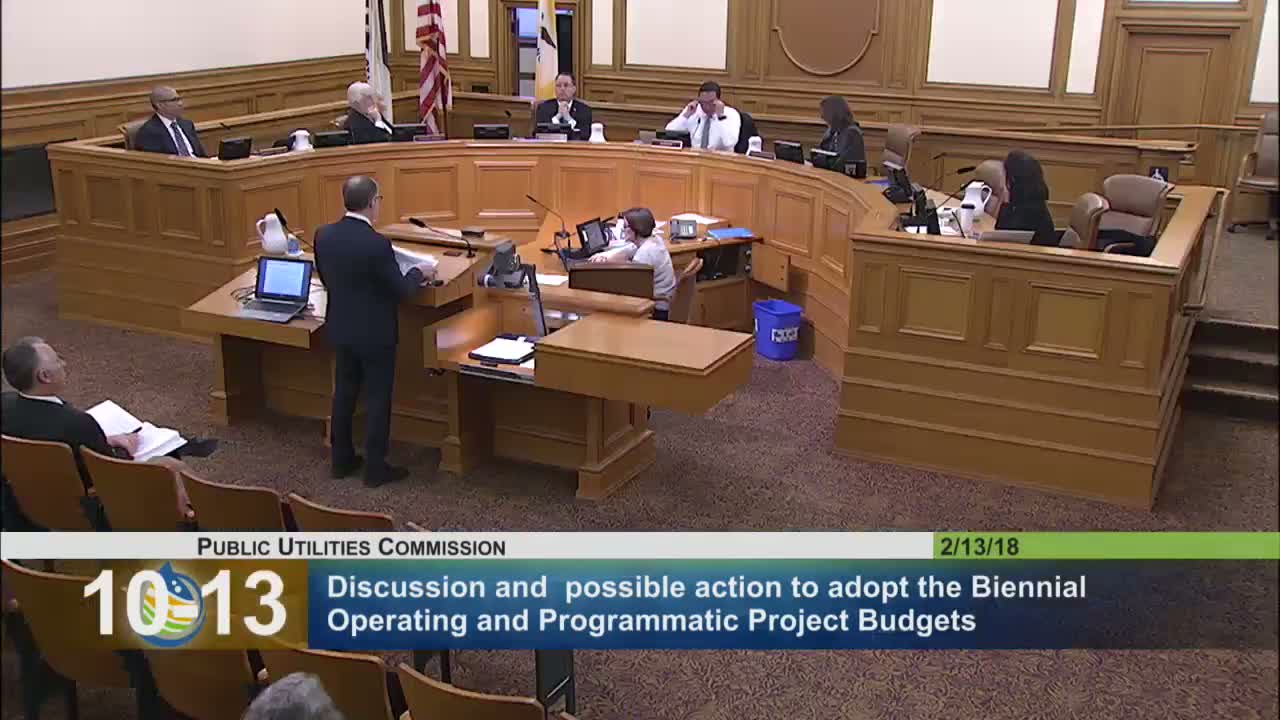
The San Francisco Public Utilities Commission on Feb. 13 approved a package of budgets and financial plans that the agency says will keep major capital projects on track while funding a citywide rollout of Clean Power SF.
The commission adopted the biennial operating and programmatic budgets, a two‑year capital budget and financing authorization, a 10‑year capital plan and a 10‑year financial plan. Staff told commissioners the combined water and sewer bill increases average about 8% per year over the next four years as the agency smooths wastewater rate changes and funds the Clean Power SF rollout.
Director Pinkham and Eric Sandler, the commission’s CFO referenced in staff remarks, said the budget package reflects more than a dozen hours of hearings and a 40‑page recap of questions and staff responses. The capital budget includes red‑line adjustments to the wastewater program — a $1 million increase in fiscal year 2018‑19 and $3 million in fiscal year 2019‑20 — and authorizes the general manager to seek Board of Supervisors approval for bond issuances. The resolutions presented financing authorizations totaling about $1.5 billion in water revenue debt, $982.8 million in wastewater revenue debt and $2.15 billion in power revenue debt (aggregate principal amounts described in staff materials).
Commissioners discussed programmatic changes added during the hearings: staff proposed accelerating a green‑infrastructure grant program targeting parks and schools, and adding pre‑apprenticeship and apprenticeship pathways tied to capital work. Commissioner questions focused on how pilot green‑infrastructure projects will inform future design and how workforce pathways will be implemented.
Tom Francis, water resources manager for consultant Bosco, urged staff to verify a $42 million forecast increase to the Water System Improvement Program (WSIP) now that budget‑tracking software is operating and asked the commission to consider extending AB 1823 oversight if the WSIP schedule moves. Steve Ritchie, assistant general manager for water, said inspections were reassuring for some transmission pipelines but that the agency continually inspects assets and will reprioritize projects if new risks emerge.
The commission voted by voice to approve each item. Next procedural steps include submittal of financing ordinances to the Board of Supervisors and return visits to the commission for specific change notices tied to large program adjustments.