Get Full Government Meeting Transcripts, Videos, & Alerts Forever!
Get email alerts on the Pier 70 topic
No spam. Unsubscribe anytime.
Commission authorizes exclusive negotiations for Pier 70 historic buildings and approves Pier 70 shore-side power as CEQA mitigation
Summary
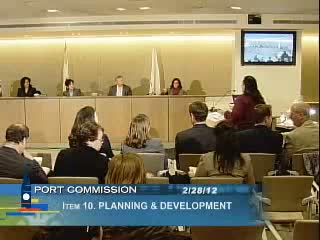
The commission authorized exclusive negotiations with Orton Development for Twentieth Street historic buildings at Pier 70, and approved a shore-side power project at Pier 70 (Resolution 1219) to mitigate air-quality impacts while Pier 27 shore power is decommissioned for cruise terminal construction; staff described financing that includes port capital, a 4'/kWh equipment charge and PUC rebates.
The Port Commission authorized staff to enter exclusive negotiations with Orton Development for a development opportunity on the Twentieth Street historic buildings at Pier 70 and approved terms to implement a shore-side power project at Pier 70 as CEQA mitigation for the Pier 27 cruise-terminal construction.
Kathleen Dyhepp, Pier 70 project manager, summarized an extensive outreach and marketing process: 176 parties toured the buildings, 15 responses to a request for interest, four RFP proposals, then two finalists after withdrawals. Staff told commissioners the primary distinction between finalists was economic feasibility: Orton proposed to commit more equity and pursue a loan model, while the other team identified a feasibility gap and sought subsidies. Staff recommended authority to enter exclusive negotiations with Orton; commissioners approved the resolution to negotiate (Resolution 12-18).
Separately, Brad Benson and Kathleen Dijap presented a shore-side power project at Pier 70 intended to offset air-quality impacts caused when the Pier 27 shore-power facility must be decommissioned for terminal construction (the existing Pier 27 shore-power facility had been funded by a combination of BAAQMD, SFPUC, EPA and port funds). Staff described a financing package that estimated total capital needs at roughly $6.4 million (staff noted $5.7 million for project costs plus reserves and issuance costs). Under a letter of intent, BAE would construct a 12-megawatt system at Pier 70; the port would fund initial capital and recover costs through a 4'-per-kilowatt-hour equipment charge passed to vessel owners; the SFPUC proposed a $1.5 million rebate contingent on system usage thresholds.
Environmental advocates and BAE representatives spoke in support, citing greenhouse-gas and air-pollutant reductions. Commissioners discussed short-term borrowing from a backlands project to bridge to long-term debt proceeds and asked clarifying questions about repayment timing. The commission voted to approve the shore-power authorization (Resolution 1219), and staff said it would return with appropriation authority if Board of Supervisors action on debt reallocation is favorable.