Get Full Government Meeting Transcripts, Videos, & Alerts Forever!
Get email alerts on the Pension topic
No spam. Unsubscribe anytime.
Vanderburgh sheriff and actuary ask county council for multi‑year funding plan to shore up pension
Summary
Sheriff Jim Robinson and actuary Kevin Carey presented a remediation plan after the county sheriff pension was placed on the state's delinquency watch list for failing to meet actuarially determined contributions. The plan asks for one‑time and phased contributions, changes to employer pay rates and potential benefit adjustments; council requested more scenarios and asked staff to return Oct. 2.
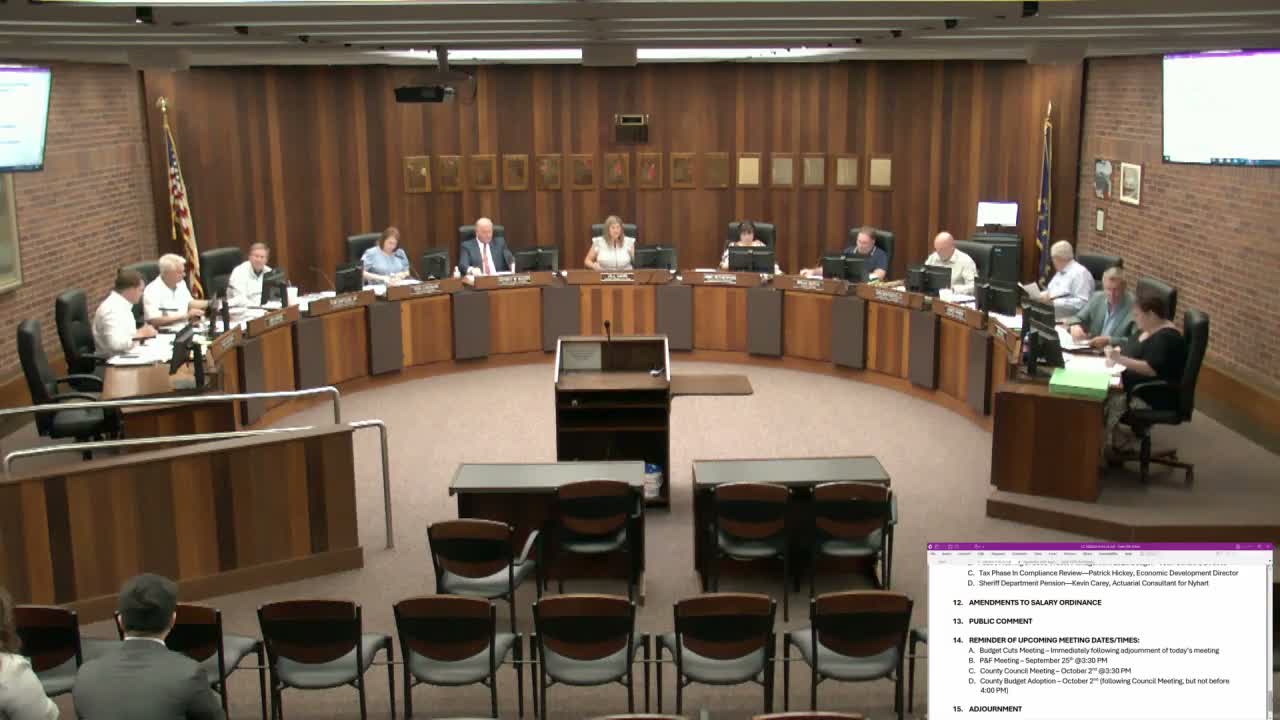
Sheriff Jim Noah Robinson and the pension plan actuary told the Vanderburgh County Council on Sept. 4 that the sheriff deputies’ pension plan has been flagged as delinquent by the state oversight committee after missing actuarially determined contributions (ADC) in multiple recent years.
The actuary, Kevin Carey of Neihart, outlined the causes and a preferred remediation approach, saying the plan’s funding shortfall stems from a combination of investment losses in 2022, recent benefit and contract cost increases and a discount-rate assumption currently set at 7.25 percent. Carey said the state considers a plan delinquent if it misses the ADC in three of the last five years and has asked the county to present a remediation plan.
Carey described the pension board’s preferred package: a $125,000 sheriff‑commissary contribution in 2024 and $100,000 annually thereafter; a council contribution of $125,000 in 2024 plus one‑third of the computed ADC in 2025–2027; and an employer contribution schedule that would increase starting in 2025 (an additional 3 percent of pay per year in the plan’s scenario) to reach a materially higher contribution rate over time. The board also proposed locking in a 2 percent pay increase for active employees in 2027 and asked the council to consider structural changes that could reduce long‑term costs, including limiting pensionable overtime.
Carey said the preferred scenario, if assumptions hold, could move the funded percentage back toward 100 percent by the mid‑2030s; he cautioned that the projection assumes steady markets and that adverse experience could erode progress.
Council members asked for alternatives and more detail. Several members raised the possibility of a large, one‑time injection, asking whether a lump‑sum payment would be more economical than phased increases. Carey said a lump sum would improve assets but would only reduce the next year’s ADC by an amortized amount, not dollar‑for‑dollar, and that he would model that option.
Council members also pressed for clear statutory guidance about what the county is legally required to pay versus what is voluntary, and asked for scenarios that include modest cost‑of‑living adjustments (COLA) for retirees and options that tie new funding to specific benefit changes (such as excluding overtime from pensionable compensation).
Sheriff Robinson requested and received the council’s permission to present the county’s range of options to the state oversight committee to show the county is actively working on remediation; council members said they expected staff and the actuary to return with more detailed scenarios, including lump‑sum and phased options, at the Oct. 2 budget meeting.
No formal vote or binding commitment was taken Sept. 4; council action is expected after the follow‑up presentation and modeling.