Get Full Government Meeting Transcripts, Videos, & Alerts Forever!
Get email alerts on the Hazardous Materials Reporting topic
No spam. Unsubscribe anytime.
Panel weighs hazardous-materials reporting fee to fund portal and emergency response teams; industry voices caution
Summary
The Office of Homeland Security urged a Tier II reporting fee to sustain an electronic submission portal and State Emergency Response Commission activities; the committee heard fee scenarios and substantial RERT funding needs but chose not to reallocate mineral revenue caps and asked for alternatives and appropriations input.
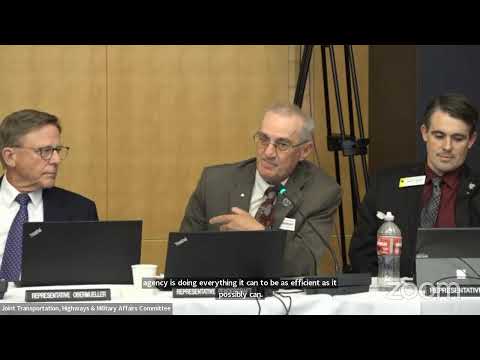
Wyoming homeland security officials urged the Transportation, Highways & Military Affairs interim committee on Tuesday to adopt a modest hazardous-materials reporting fee to pay for an electronic Tier II submission portal and to support State Emergency Response Commission (SERC) activities and local emergency planning committees.
Talise Hanson presented bill draft 25LSO0084, which would add a new subsection authorizing a per-filing fee for facilities required to submit Tier II reports under federal law (42 U.S.C. §11022). The draft leaves the per-filing amount and an annual cap to the committee and proposes an applicability and effective date of July 1, 2025 for filings on or after that date.
Lynn Budd, director of the Wyoming Office of Homeland Security, said federal grant funding has declined and the state needs a revenue source to cover a required electronic submission portal (software costs now roughly $64,000/year) and to support in-person SERC meetings and local emergency planning committees. Radiological and hazardous-materials specialist Nick Wardle presented a data model showing roughly 9,444 private/commercial facilities would be subject to fees under the bill as written and illustrated how per-filing fees interact with company-level caps to avoid excessive burdens for large multiple-facility firms.
Wardle and Budd suggested a model roughly centered on $50 per filing with a $5,000 annual cap per company; with those parameters their spreadsheet yields an estimate in the low hundreds of thousands of dollars per year (Wardle cited roughly $218,000/year under an example column) and would permit limited LEPC support and match funding for federal grants.
Industry witnesses were cautiously supportive of sustaining the SERC but urged prudence. Travis Detaime (Wyoming Mining Association and Petroleum Association) said some members would accept a modest per-form fee (he mentioned $40 as an example) while others opposed added fees on already heavily taxed industries and urged the committee to consider alternatives, including using existing revenue streams.
Committee discussion ranged beyond the portal to funding for Regional Emergency Response Teams (RERTs) and bomb-squad equipment. Budd reported that equipment needs across the RERTs could total millions per team (estimates cited around $1.5 million per team in some prioritizations), that an earlier appropriation provided partial support and that federal homeland-security grants have declined from prior levels. RERT and fire-service witnesses described aging equipment purchased after 9/11, replacement needs for tractor-trailer apparatus and newer detection technologies, and urged stable funding.
Committee members proposed multiple financing options including a narrowly tailored per-filing fee, drawing on general fund or federal mineral royalty/severance distributions, and a Montana-style state trust approach. A motion to draft bills to alter distributions of federal mineral royalties and severance taxes to earmark funds for homeland security and RERT support was debated and ultimately failed on a recorded hand count. Committee leadership proposed instead drafting a letter to the Appropriations Committee recommending one-time general fund support and to continue evaluating revenue options.
What’s next: LSO will incorporate committee direction into follow-up materials; committee asked for more targeted industry input, a fiscal estimate for the chosen fee/cap combination, and additional data on RERT costs and cooperation arrangements for a later meeting.