Get Full Government Meeting Transcripts, Videos, & Alerts Forever!
Get email alerts on the It Budget topic
No spam. Unsubscribe anytime.
County CIO says joint IT budget rises as sheriff, courts move into shared system; asks for servers, staff and cybersecurity upgrades
Summary
Vernon Lutz, the county and city chief information officer, told council the joint computer services budget shows large percentage increases because the sheriff’s office and courts were added, older servers need replacement, licensing expanded and new cybersecurity layers are required. He requested two new staff positions and explained expected savings and one‑time contractual costs.
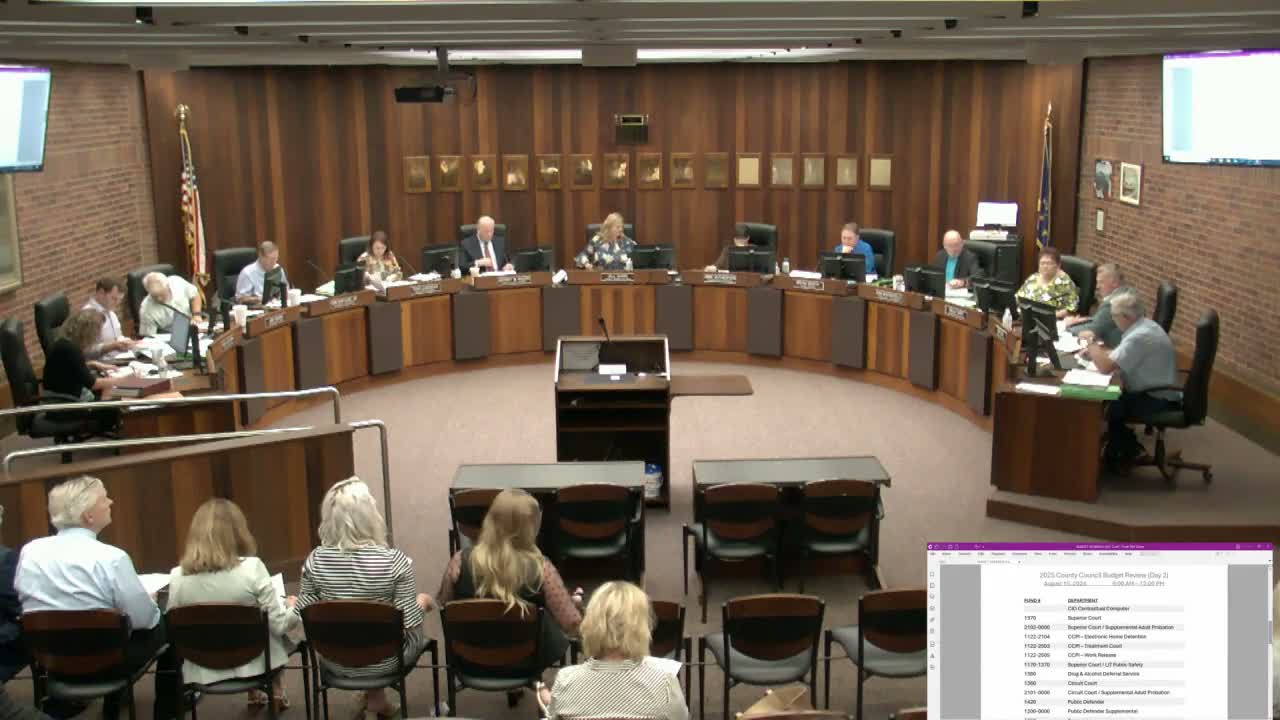
Vernon Lutz, chief information officer for the city and county, told the Vanderburgh County Council during its Aug. 15 budget hearing that the computer services line items appear to rise sharply mainly because the sheriff’s office and the courts were recently added to the joint IT budget.
Lutz said the county portion of the joint budget increases 10.74% while the city’s share rises 8.72%, and pointed to several specific drivers: legacy “data center” servers approaching nine years of age that he recommends replacing through a five‑year lease; enterprise licensing growth from roughly 250 new users tied to the sheriff’s office integration; and one‑time professional service contracts for projects such as a phone‑system upgrade. “We have 1,092 computers [in] the county, and the city has 1,011 computers,” Lutz said, noting that bringing the sheriff into the joint environment shifted both user counts and certain costs.
Lutz highlighted cost reductions that offset some increases: terminating redundant telecommunications, negotiating a $12,000 annual saving on a SIP trunk renewal, and a roughly $54,000 annual saving from a recent Internet contract negotiation. He said a consolidated approach has yielded larger procurement leverage and that some costs (for example, Microsoft licensing previously paid by the sheriff) are now centralized in the computer services budget with net system‑level savings.
Cybersecurity featured prominently in the presentation. Lutz briefed the council on measures already implemented—two‑factor authentication, immutable backups and other best practices—and proposed adding Cisco ISE/microsegmentation to harden network ports and limit lateral movement during an intrusion. He said a stronger security posture had helped reduce the county’s cyber insurance premium and cautioned that insurers are increasingly using exclusions and stricter underwriting. “We do carry a cyber insurance policy,” he said, noting the changing policy landscape and the need to meet insurer mitigation requirements to maintain coverage.
On capital and personnel, Lutz explained the server replacement plan: a roughly $400,000 replacement amortized as a $150,000 county lease payment in the budget year; and he asked to add two positions—a project manager and an engineer—to manage growth and ongoing projects. Lutz said those roles would help reduce long‑term costs and better manage vendor work and internal projects.
Council members pressed for detail on line‑item mapping and asked where the increases appear across funds; staff agreed to supply the specific account numbers and updated rationale sheets. Lutz offered to meet individually with council members on budget specifics.
The council did not act on any IT budget items at the hearing; this session was for discussion only. Staff said line items and narrative rationales will be corrected in the published budget materials before formal appropriation votes later in the process.