Get Full Government Meeting Transcripts, Videos, & Alerts Forever!
Get email alerts on the Public Safety topic
No spam. Unsubscribe anytime.
Milledgeville police demonstrate drone and forensic upgrades, touting quicker case turnaround
Summary
Police leaders showed the City Council new forensic-lab tools and a drone program they say has improved search-and-rescue, crash reconstruction and suspect tracking; presenters stressed FAA compliance, officer safety and that some equipment (thermal cameras) carries a high cost but exact vendor pricing was not provided.
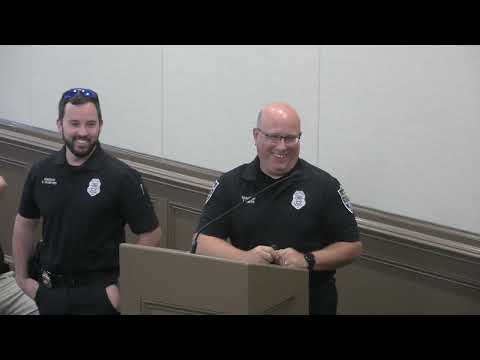
Chief Dre Schweickart and members of the Milledgeville Police Department gave City Council a detailed briefing on the department's expanding technology capabilities, including a new forensic lab and a five‑drone fleet the department is using for crash reconstruction, search-and-rescue and suspect tracking.
'We just rolled over into a lot more equipment that we're using to fight crime,' Chief Dre Schweickart said, introducing Lieutenant Philip Vincent, Sergeant Brandon Crawford and Sergeant Thomas Smith to demonstrate the gear and videos.
Sergeant Thomas Smith, who described himself as the department's traffic investigator and a drone pilot, walked the council through deployments the unit has handled this year. He said the department has logged roughly 30 deployment requests so far in 2024 from the city and other agencies and highlighted examples including nighttime thermal searches, overhead crash mapping with 3D models and overwatch at large public events.
'This helps DNR go to some of those places'where it would take a couple of hours for them to get a person over there,' Smith said when describing a drone response to a drowning near a dam. He also showed a crash model that can be measured to within centimeters and presented thermal (FLIR) footage of suspects located at night.
Presenters emphasized training and regulatory compliance. Lieutenant Philip Vincent described the unit's FAA Part 107 authorization and said all pilots hold FAA certifications. Smith explained the role of a visual observer in night operations and clarified FLIR's limits: 'it doesn't let you see through heavy brush or walls.'
Council members asked about costs and equipment lifecycle. Smith said the thermal camera is the single most expensive component and described package features (external battery packs, hot‑swap battery cases, a field monitor) but did not provide a specific vendor price during the meeting. When asked whether the department could recoup value from older equipment, Smith said resell or redeployment options were not yet fully explored.
City Manager Mister Griffith and council members framed the investment as public‑safety and officer‑safety spending, praising the department's training and cross‑agency assistance. The presentation closed with council offers to arrange demonstrations for interested members.
The mayor and several councilors thanked the department and asked staff to keep council informed ahead of budget cycles so the city can maintain its equipment leadership in the region.