Get Full Government Meeting Transcripts, Videos, & Alerts Forever!
Get email alerts on the Housing Production Strategy topic
No spam. Unsubscribe anytime.
Sandy hears state housing-production rules as consultants flag wastewater moratorium as key constraint
Summary
DLCD and consultants told the Sandy City Council that the state-mandated Housing Production Strategy (HPS) must be adopted by 12/31/2025 and should address locally contextualized housing needs; consultants said wastewater capacity and high utility rates will limit near-term housing production and suggested funding, code changes and partnerships as potential actions.
Council President Smallwood convened a work session on the state-mandated Housing Production Strategy on the evening the council met; Tyler opened the session and introduced consultants from ECHO Northwest and a Department of Land Conservation and Development (DLCD) regional representative.
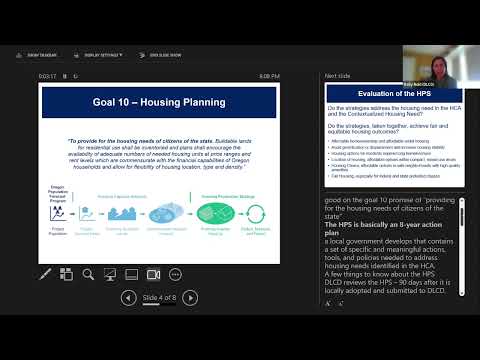
DLCD’s regional representative, Kelly, summarized why the HPS exists and what the state will review: “do the strategies in your HPS address the housing need that you found,” she said, emphasizing the HPS’s three goals — production, affordability and choice — and explaining that DLCD has 90 days to review a locally adopted HPS and may approve, approve with conditions or remand it. Tyler reminded the council the HPS must be adopted by 12/31/2025.
Consultants from ECHO Northwest said the HPS is an eight‑year action plan that must link specific strategies to the housing needs identified in Sandy’s housing capacity analysis. They summarized stakeholder interviews and the local picture: rising housing and utility costs were straining young families, single parents, lower‑income workers and seniors; local nonprofits and service providers report limited capacity; and the city lacks transitional and emergency housing.
Multiple participants pressed the consultants on Sandy‑specific constraints. Consultants repeatedly identified wastewater and water capacity as the dominant near‑term limits to new housing. One speaker referenced earlier cost estimates for wastewater improvements in the hundreds of millions of dollars (a figure of about 130,000,000 was cited in discussion), and speakers noted that available ERUs and permit caps will constrain development until infrastructure is addressed.
Given those constraints, consultants proposed a mix of actions the city can control or pursue in partnership: seeking grant funding for wastewater facilities, considering a construction excise tax to seed affordable housing funds, exploring urban renewal set‑asides, using publicly owned land for housing, adopting development‑code changes (for example, cottage clusters and pre‑approved ADU plan sets), and targeted outreach and design changes to lower regulatory barriers and speed permitting for income‑restricted projects. They emphasized that no single action is a silver bullet and recommended 10–15 focused actions sized to staff capacity.
The council probed how DLCD will treat cities with infrastructure limits. Kelly said DLCD staff are aware of moratoria and capacity limits and that the housing acceleration program now in rulemaking could offer technical assistance to jurisdictions that are not making progress; she also noted DLCD has been able to provide grant funding to support planning and code work and expects some continued grant support for implementation.
Councilors asked the consultants to prioritize low‑cost, near‑term items (for example, tracking short‑term rentals, expedited permitting for income‑restricted projects, and better communication about existing assistance programs) while continuing to pursue large‑scale funding for infrastructure. Staff and consultants agreed to consolidate council feedback and circulate the consultant notes and slides for further comment.
Next steps: staff will collect council feedback and return with a draft HPS and a recommended action list and schedule; the council and staff indicated they expect the city’s HPS to explicitly note current wastewater and utility constraints and to set realistic, locally contextualized actions for the eight‑year plan.