Get Full Government Meeting Transcripts, Videos, & Alerts Forever!
Get email alerts on the Tax Abatement topic
No spam. Unsubscribe anytime.
County approves 80% tax abatement for Phillips 66 after company outlines environmental, energy upgrades
Summary
The Yellowstone County Board of County Commissioners voted to approve Resolution 24-58, granting Phillips 66 an 80% tax abatement on Class 8 property after company representatives described projects to reduce emissions and energy use.
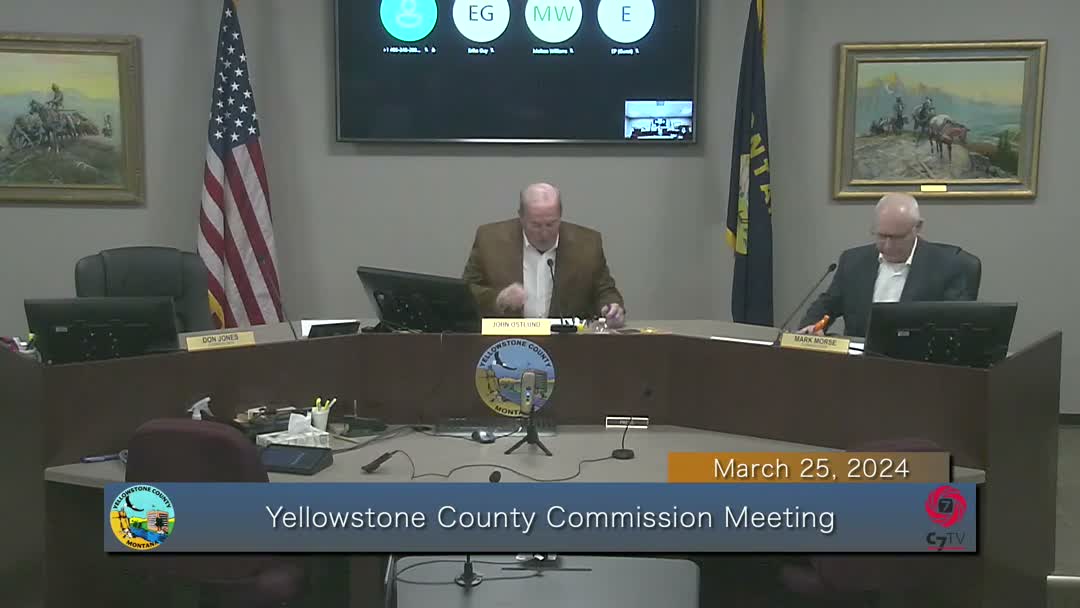
The Yellowstone County Board of County Commissioners approved Resolution 24-58 on March 26, granting Phillips 66 an 80% tax abatement on Class 8 property after a brief public hearing and a company presentation.
The abatement request was presented by company representatives who described two capital projects: upgrades to a sour-water-stripping system that captures sulfur for fertilizer and a set of heat exchangers that increase preheating and reduce furnace firing. “This project allows us to sell more fertilizer and actually take it out of the atmosphere,” said Howard Butler, project development supervisor for Phillips 66, describing the sulfur-recovery work. Butler said the heat-exchanger work also saves fuel gas, producing both environmental and energy benefits.
The chair opened the public hearing and invited comment; no members of the public spoke against the request. After the hearing, Commissioner Morris moved to approve Resolution 24-58 to grant the tax abatement to Phillips 66 on Class 8 property at 80%. The motion was seconded and carried on a voice vote.
County discussion at the hearing was limited to clarifying questions; no amendments or conditions were added to the motion. The company’s presentation noted both environmental controls and energy savings as the rationale for the abatement, and the board’s passage allows the company to proceed under the agreed-abatement terms.
The resolution was approved during the March 26 meeting; the record does not specify subsequent administrative steps, such as formal execution of an abatement agreement or the effective date of the tax relief.