Get Full Government Meeting Transcripts, Videos, & Alerts Forever!
Get email alerts on the Pension Funding topic
No spam. Unsubscribe anytime.
Actuary outlines multi‑option plan as Vanderburgh sheriff’s pension falls to 73% funded
Summary
An actuary presented four remediation scenarios to Vanderburgh County Council after the sheriff’s pension funded ratio fell from about 94% (2022) to 73% (2023); options ranged from a large one‑time contribution to ongoing higher percentage‑of‑pay contributions, and council requested an independent actuarial review.
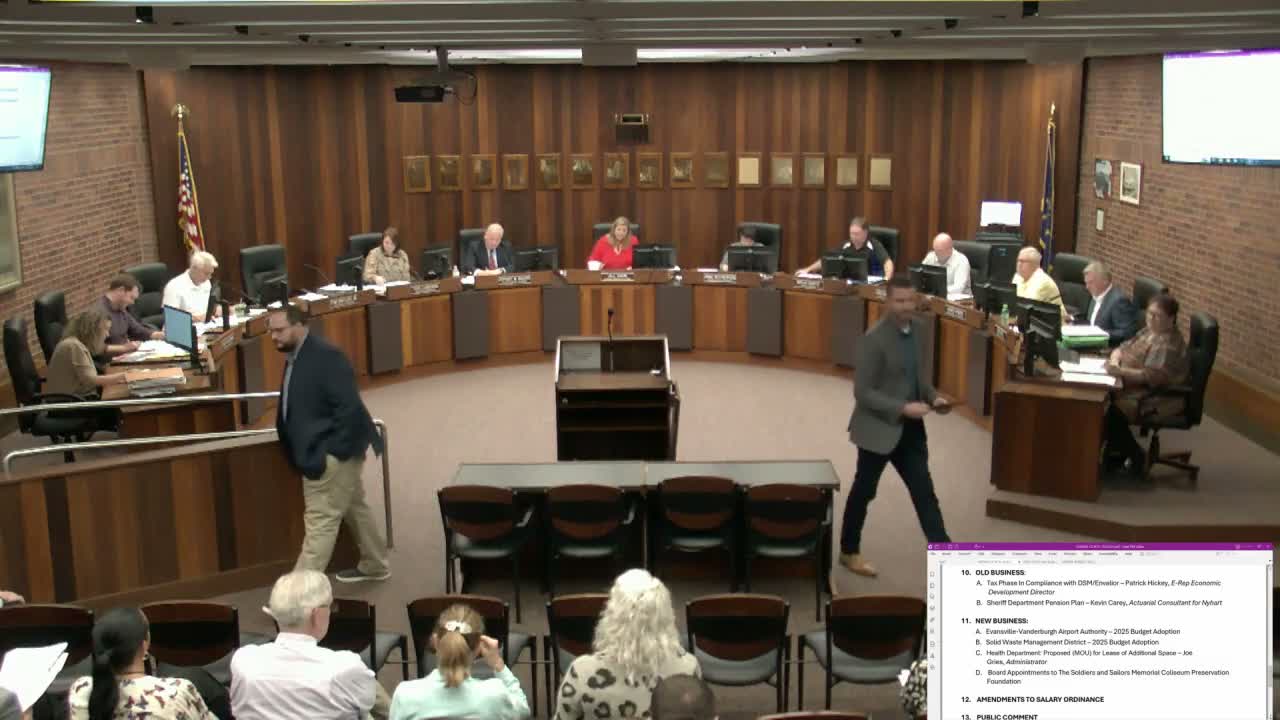
Sheriff Noah Robinson and an actuary presented to Vanderburgh County Council on Oct. 2 after the county’s sheriff pension plan’s funded ratio declined to roughly 73% in 2023.
The actuary outlined four remediation scenarios: two that rely on one‑time lump contributions and two that change employer contribution rates. Using updated August asset values, a one‑time contribution to return the plan to a 100% funded position by the plan’s target year was estimated at about $8.7 million (option 1), while a less aggressive one‑time contribution to allow the current schedule to meet actuarially determined contributions (ADCs) was estimated near $2.5 million (option 2). Alternative scenarios showed higher ongoing employer contribution rates — roughly the mid‑20s percentage of pay in the most aggressive scenario — while the option to set a flat annual contribution large enough to meet each year’s ADC was estimated in the high teens percentage range.
The actuary cautioned these projections depend on assumptions, including a long‑term investment return (discount rate) assumed at 7.25 percent and recurring fee‑based contributions estimated at about 2% of payroll. “Investments have performed well the last few months,” the actuary told council, “but we don’t want to get too excited because things can swing the other way.”
Councilors asked several technical questions, including whether a net present value analysis of future employer contributions would change the comparative cost of options and whether borrowing to cover a lump sum might be less costly depending on market rates. One councilor said borrowing could, depending on terms, be cheaper than large one‑time contributions over time.
Sheriff Robinson described the proposed sheriff contribution from the commissary fund and warned the transfer would “sting” but said it was within the comfort level of the sheriff’s office. “Roughly, we sit on a balance of anywhere from $400,000 to $1 million,” Robinson said of the commissary, noting the balance fluctuates with operational needs and purchases.
Council agreed to hire an independent actuarial firm as a second opinion to validate assumptions and return with findings before final decisions. No formal funding decision was taken at the Oct. 2 meeting.