Get Full Government Meeting Transcripts, Videos, & Alerts Forever!
Get email alerts on the Use Of Force topic
No spam. Unsubscribe anytime.
San Francisco Police Commission adopts new use-of-force policy after months of negotiations
Summary
After months of stakeholder meetings and DOJ input, the Police Commission voted unanimously to advance a revised Departmental General Order (5.01, version 3) on use of force to meet-and-confer with the Police Officers Association, emphasizing mandatory de-escalation, data collection, and a strict limit on shooting into moving vehicles.
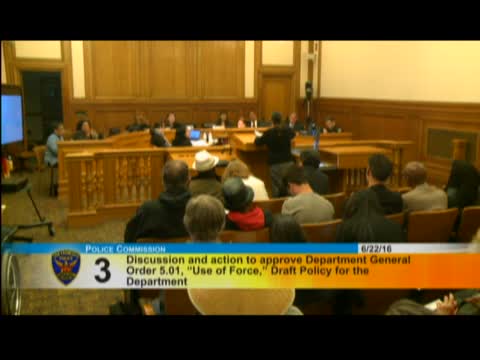
The San Francisco Police Commission voted unanimously June 22 to adopt a revised departmental general order on use of force (DGO 5.01, version 3) and forward it to the meet-and-confer process with the Police Officers Association (POA).
The commission’s action follows more than six months of public meetings, stakeholder working groups, and input from the Department of Justice. President Denise Loftus said the process produced broad agreement on core principles and that the new draft seeks to be clear and implementable. Commissioners identified a dozen unresolved items and reached consensus on how to present those areas to negotiators.
Why it matters: The policy sets department-wide standards for when and how officers may use force, and it will shape training, reporting and discipline. The adopted version makes de-escalation a mandatory principle, requires stronger data collection on force incidents, and contains a prohibition — with narrow exceptions — on firing at vehicle occupants.
What the policy does and does not do - De-escalation: The draft centers de-escalation as a required component of decision-making. Stakeholder representative Samra Marion said, “So what I see is a policy where deescalation is front and center, and then there’s accountability throughout.” - Minimal force standard: The policy reaffirmed a "minimal force" objective — the lowest level of objectively reasonable force necessary to achieve lawful objectives without increasing risk to others. - Shooting at moving vehicles: Commissioners adopted language that generally forbids discharging a firearm at the operator or occupants of a moving vehicle unless the person poses an immediate threat of death or serious bodily injury by means other than the vehicle itself. - Carotid restraint and other disputed techniques: The commission removed multiple scattered references to the carotid restraint and consolidated its approach so the document reads consistently; that technique remains an open issue to be addressed in meet-and-confer where the POA has preserved its bargaining rights. - Reportable force and OCC referrals: The draft directs officers and supervisors to report suspected unreasonable force and clarifies internal reporting steps; the OCC and department will coordinate to ensure the Office of Citizen Complaints receives timely notifications.
Negotiation and legal limits Commissioners and the Department of Human Resources acknowledged that state labor law and the San Francisco Charter give the POA the right to raise issues in meet-and-confer where the union argues an item affects terms or conditions of employment. DHR advised the commission it will evaluate which provisions fall within the scope of bargaining and which are fundamental policy.
POA position and public response The Police Officers Association participated in the drafting process and said much of the text reflects compromises. POA representatives told the commission they view roughly 80% of the document as acceptable, but said they must preserve meet-and-confer rights on several safety- and discipline-related items. POA president Marty Heller stated he could not surrender those rights "here and now," noting potential cross-effects between disputed and agreed language.
Public comment ranged from direct support for tough reform and greater accountability to concerns that the process had been rushed. Mental-health and community advocates praised the emphasis on de-escalation and data collection but reiterated calls to ban specific techniques and to ensure front-line accountability.
Next steps The commission approved version 3 as the draft to send to DHR and the POA for meet-and-confer. If the parties reach agreement, the commission will vote on the negotiated language for final adoption; if they cannot, DHR and legal counsel will determine which points are subject to arbitration or litigation.
The commission also discussed implementation: commissioners asked the department to begin planning training and data systems immediately for those provisions where stakeholders and department subject-matter experts are aligned so the SFPD can begin operational changes without undue delay.
Outcome and vote The motion to advance DGO 5.01 version 3 passed 7–0.
What’s next: The commission will monitor meet-and-confer progress, receive DHR advice on scope questions and follow up on training plans and public reporting requirements.