Get Full Government Meeting Transcripts, Videos, & Alerts Forever!
Get email alerts on the Power Irp topic
No spam. Unsubscribe anytime.
SFPUC presents Hetch Hetchy Integrated Resource Plan; finds Moccasin investments uneconomic in some scenarios
Summary
The San Francisco Public Utilities Commission heard a staff presentation on the Hetch Hetchy Integrated Resource Plan showing Hetch Hetchy’s 395 MW of generation, scenario analysis over 25 years, and a finding that Moccasin powerhouse is uneconomic under key scenarios while preserving Hetch Hetchy ownership scores in other portfolios.
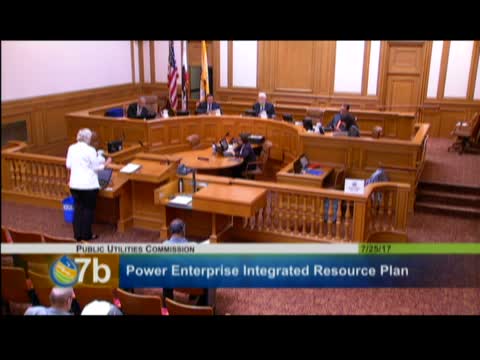
Lori Mitchell, manager of the Power Supply Group, presented the Hetch Hetchy Integrated Resource Plan to the San Francisco Public Utilities Commission on July 25, outlining assumptions, scenarios and recommended portfolios for the utility’s hydro-based generation assets.
Mitchell said the Hetch Hetchy system’s total generation is about 395 megawatts, including roughly 380 MW from Hetch Hetchy supplies and about 15 MW of other renewables. The system’s immediate internal load for Hetch Hetchy customers is about 150 MW, leaving a spring runoff period with excess generation that is often sold into the market at low prices, she said.
Staff modeled multiple 25-year scenarios and sensitivities — including wet and drought hydrology, levels of distributed energy resources, and a range of market-price forecasts — to compare capital investments, operational risk and policy outcomes. The IRP examined three primary scenarios: (1) invest in the approved 10‑year capital plan plus unfunded projects; (2) a near-term delay of some projects (largely rejected as unfavorable); and (3) defer investments at Moccasin powerhouse to reduce near-term spending and market exposure.
The study found that Kirkwood and Holm powerhouses are the least‑cost assets (Mitchell cited dispatch costs of about $15/MWh for Kirkwood and $19/MWh for Holm), while Moccasin is the most expensive dispatch resource in many scenarios (staff cited values up to $84/MWh and noted one five‑year outlook with a Moccasin cost near $110/MWh). Under qualitative scoring of capital risk, market exposure and flexibility, the portfolio that defers Moccasin investment (scenario 3) scored better on several risk metrics, though scenario 1 better preserved long‑term ownership, intrinsic value and operational redundancy.
Mitchell said the IRP is not intended to replace operations, maintenance, budgeting or contract obligations. It is a planning tool to identify plausible assumptions and adaptive pathways. Staff emphasized coordination with city goals, the water enterprise’s needs and the city attorney’s office, and said decisions about specific capital projects will continue through the existing capital and budgeting process.
Commissioners asked about how the IRP treats renewable‑portfolio standard (RPS) accounting for large hydro; Mitchell said the state rules are in flux, that large hydro’s RPS treatment was still under consideration, and early indications suggested hydro would be counted but the matter was unresolved. Commissioners also asked for clarification on inflation assumptions, seasonal market‑price drivers and the short‑term (five‑year) cost outlook; staff gave numerical examples of recent market prices and explained the modeling assumptions.
The presentation concluded with staff noting the IRP’s three key conclusions: the system can meet its projected needs, generation at Moccasin is uneconomic in some modeled futures, and balancing load and generation with an appropriate portfolio can reduce exposure to market price volatility. Commissioners characterized the IRP as analytic and thought‑provoking and treated it as the start of a longer decision process rather than an immediate action item.
Next steps include continued scenario work, coordination with state proceedings affecting RPS and power‑market rules, and later presentation of a Clean Power SF IRP for that program’s customers.