Get Full Government Meeting Transcripts, Videos, & Alerts Forever!
Get email alerts on the Budget Staffing topic
No spam. Unsubscribe anytime.
Carmel board debates budget and staffing after clerical cuts and elimination of float nurses; approves $2.12M transfers and electrification study
Summary
Trustees heard union and public concerns about a roughly 10% reduction to clerical staff and the removal of two float nurses, debated using an agency for nursing coverage, questioned a financial-adviser RFP and long-range planning, approved $2,122,762 in budget transfers and awarded a BOCES electric-bus feasibility study (approx. $18,000).
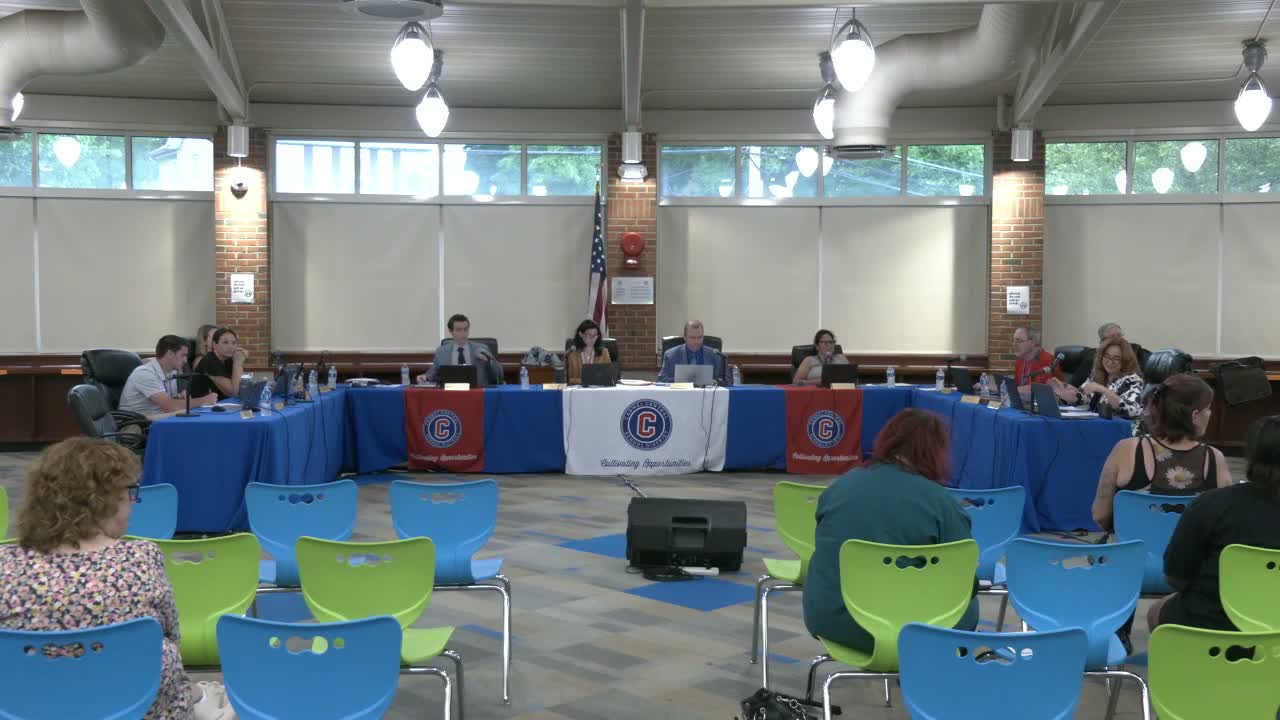
The Carmel Central School District board spent much of its June 18 meeting on contested budget and staffing decisions, with union leaders and trustees pressing administrators for clearer documentation and long‑range planning.
Barbara Faranda, representing the Carmel Office Staff Association (COSA), told the board her unit was reduced by approximately 10% this budget cycle and that clerical overtime lines were cut to zero. "We're down bodies," she said, adding that the district should create a separate budget line to show overtime claimed by clerical staff so expenses are transparent.
Trustees and staff discussed other personnel changes, including the elimination of two district “float” nurse positions intended to reduce costs by about $200,000. Interim district staff said the district has contracted with an agency to provide temporary nurse coverage when district substitutes are not available and that the agency has filled needs "at least a dozen times" since contracting. Dr. Kennedy said the agency has generally been able to provide coverage for field trips and some building needs, but administration conceded it cannot guarantee the agency will always be able to supply nurses for large buildings or every absence.
Trustees expressed concern about continuity of care when agency nurses rotate in and out of buildings and asked administration to monitor costs carefully. "If we're using the agency more than we projected, the board needs to know," one trustee said.
On finances, trustees debated the district’s RFP to appoint a financial adviser. Some trustees questioned prior advice that the district replace expiring debt with comparable new borrowing to preserve capital exclusions and thus increase the tax-cap calculation, saying they wanted a broader long‑range financial planner rather than a bond‑only adviser. Administration said the RFP followed best practices and three firms responded; several board members asked staff to reopen or amend the RFP to include long-range financial planning and to solicit additional firms, including R.G. Tims.
The board approved several formal items: a package of budget transfers totaling $2,122,762 to close out the 2023‑24 general fund and a separate $80,000 transfer for special-education needs. A roll-call vote approved routine personnel actions as presented.
The board also accepted Putnam Northern Westchester BOCES’ recommendation and awarded an electrification feasibility study to I and F (INF) Associates at an expected net district cost of roughly $18,000, funded from savings in a contractual line item; administration said the study would inform the district’s approach to an unfunded state mandate to begin purchasing electric buses in 2027, and that fleet size, geography (district square miles) and wealth ratio affect estimated costs and grant eligibility.
Several trustees said they want a broader financial‑planning RFP that lays out five- and ten‑year projections and workload for bonding, debt service and operational trade‑offs before key financing decisions.