Get Full Government Meeting Transcripts, Videos, & Alerts Forever!
Get email alerts on the Use Of Force Policy topic
No spam. Unsubscribe anytime.
San Francisco commission weighs DOJ recommendations as it rewrites use-of-force policy
Summary
The Police Commission reviewed Department of Justice (COPS) feedback on a proposed single, simplified use-of-force policy that centers the 'sanctity of life,' recommends improved tracking and community oversight and leaves the question of tasers to local decision-making.
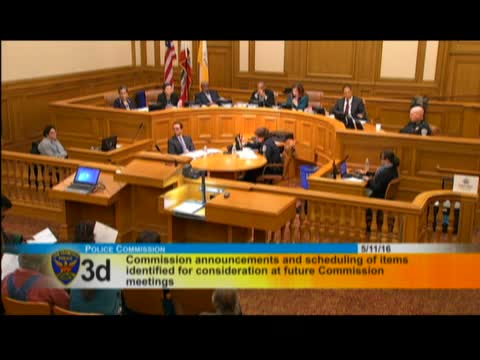
The San Francisco Police Commission on May 11 reviewed feedback from the U.S. Department of Justice’s Office of Community Oriented Policing Services on the commission’s draft use-of-force policy and resolved to incorporate clearer, simpler language and stronger accountability measures before taking the policy to the public.
Commission President Loftus said the DOJ praised the city’s level of stakeholder engagement but urged the commission to consolidate multiple use-of-force directives into a single, officer-readable policy and to make expectations explicit. "The key principle is putting the sanctity of life at the core of what the policy is and what the training is," Loftus said during the presentation of the memorandum. She said commissioners will reconvene a subcommittee and return a revised draft on June 1.
The DOJ’s written feedback, discussed in the meeting packet and summarized aloud by the president, endorsed several concrete changes the commission is considering: simplifying and clarifying language so rank-and-file officers can readily apply the rules; specifying which uses of force will be tracked publicly; establishing protocols for independent criminal investigations in cases of officer-involved death, and creating a serious-incident review board that includes community members.
Commissioners repeatedly stressed that the policy must not be merely aspirational. "If the policy cannot be understood by an officer reading or referencing them, then the policy has not fulfilled the intended purpose," one commissioner said, echoing points in the DOJ memo. Commissioners asked the chief and staff to ensure the new language is both legally sound and operationally useful for officers in the field.
The draft did not require a particular stance on tasers, and the DOJ declined to make an explicit recommendation on that device, providing instead technical feedback that would apply if the commission chose to authorize conducted energy devices. Community speakers urged the commission to reject tasers; some commissioners said the device should remain under active review while other members and the department described the need to preserve officers’ ability to protect themselves and others in extreme situations.
The chief of police and Police Officers Association (POA) representatives who addressed the commission recommended plain-language definitions of force levels and highlighted training aligned with state standards. The POA pointed the commission to POST (Peace Officer Standards and Training) definitions and said those charts helped translate force options for everyday patrol work.
Loftus instructed Commissioners De Jesus and Mizuko to join a subcommittee with her to reconcile the competing stakeholder redlines and DOJ comments and bring a revised draft back June 1, followed by two community meetings before a final vote. The commission also indicated it will consider DOJ proposals for public release of selected data and for a community-inclusive incident review process.
Next steps set by the commission are: subcommittee deliberations, a revised draft on the June 1 agenda, two community meetings for final public feedback and a planned vote after that public review.