Get Full Government Meeting Transcripts, Videos, & Alerts Forever!
Get email alerts on the Code Of Conduct topic
No spam. Unsubscribe anytime.
Carmel Central policy committee revises Code of Conduct draft, removes strip-search language and debates dress-code exception
Summary
The district’s policy committee reviewed changes to the Code of Conduct, agreed to remove strip-search language, discussed restorative-practice wording and PBIS rollout, and debated a longstanding sideline tradition that allows some students to attend events shirtless.
CARMEL, N.Y. — The Carmel Central School District policy committee spent its July 15 meeting focused on revisions to the district’s Code of Conduct, agreeing to remove strip-search language and to tighten how searches and confiscations are described in the draft policy.
The committee’s discussion, led by a policy subgroup, front-loaded several substantive decisions: removing explicit strip-search procedures, clarifying that searches are conducted by the building principal or a principal’s designee, and limiting staff authority to view students’ phones without legal guidance. "There's no reason for it," the committee chair said when the strip-search provision was raised; "We are taking strip searches out," added another member during the debate.
Why it matters: the code sets the district’s standards for student and adult behavior, disciplinary referrals and appeals, and where and how the district enforces rules. Changes to search procedures, documentation requirements and definitions of major vs. minor incidents affect student privacy, due process rights and how quickly students can return to class after discipline.
The committee also discussed restorative-practice language and supports. Members agreed to replace repeated instances of the word "rules" with "expectations" where appropriate and to embed clearer restorative language across sections covering teachers, principals and other staff. A committee member said PBIS (Positive Behavioral Interventions and Supports) "lives and breathes" in most elementary and middle-school buildings but needs attention at the high-school level; staff will review campus implementation. The group directed staff to draft a list distinguishing "major" and "minor" incidents so administrators can apply restorative responses without being constrained by the policy text.
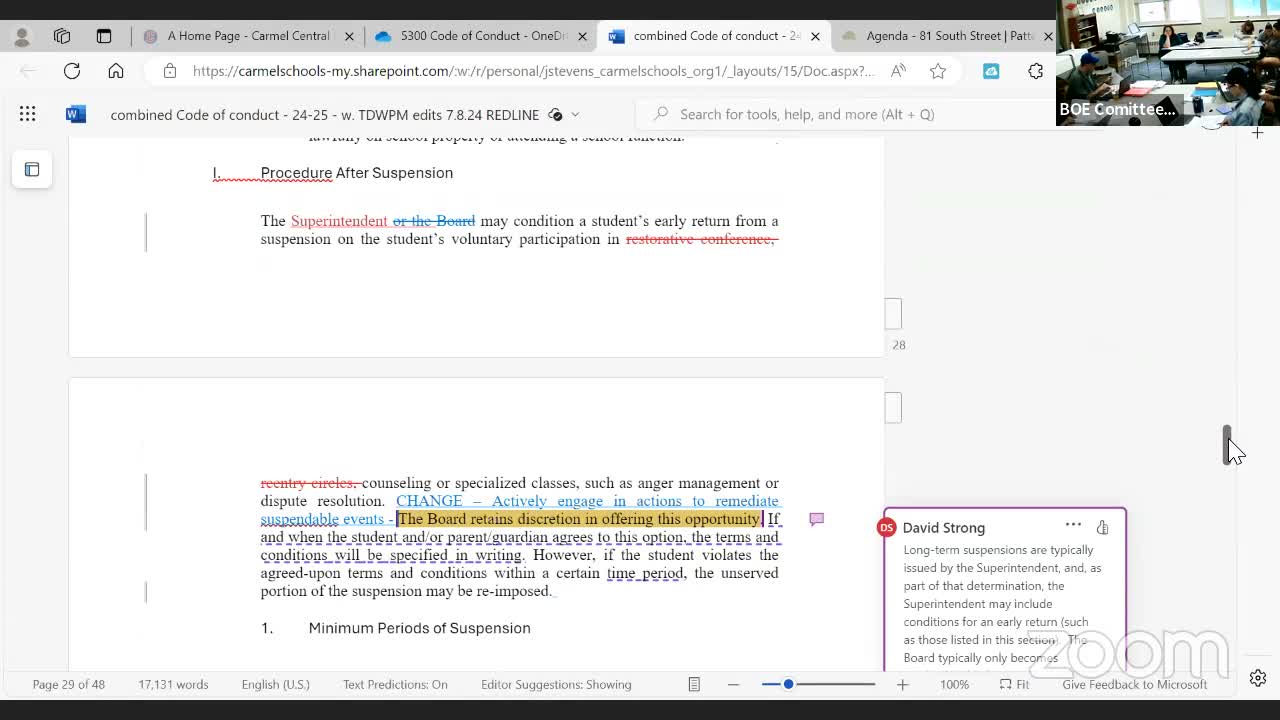
Disciplinary timeframes were debated. The committee discussed keeping different timeframes for short-term and long-term suspensions rather than making them uniform as legal counsel had suggested. The board’s direct involvement was described as tied to appeals: "The board only becomes involved with a long-term suspension in the event of an appeal," one participant said.
Dress code and athletic-event traditions drew an extended exchange after a committee member noted a long-standing spectator group (referred to in the meeting as "the Carmel Crazies") in which some boys attend events shirtless. The member urged the committee to decide whether the district will explicitly prohibit shirtlessness at school events or modify the code for equity, noting potential Title IX implications if rules apply differently to girls and boys. "If we're allowing that as a district, we can't tell girls that they have to cover themselves," the committee member said, adding the language should be fixed "to make it appropriate for everyone" or removed.
On documentation, the committee clarified that teachers must complete a disciplinary referral (not merely a log) for every removal from class so incidents are captured in district systems and in any subsequent review by principals or designees.
Next steps: the committee asked staff to locate unclear acronyms in the draft, to remove or reword problematic passages, to draft the major/minor incident list, and to circulate revisions before a follow-up policy meeting scheduled for July 29. Committee members also asked that revised text be posted on the district website and that administrators and the district attorney’s office review specific enforcement language in between meetings.
Speakers quoted in this account are identified by the same labels used in the meeting transcript (e.g., Speaker 3 is the committee member who led the policy presentation) because no formal staff titles were provided in the transcript.