Get Full Government Meeting Transcripts, Videos, & Alerts Forever!
Get email alerts on the Use Of Force Policy topic
No spam. Unsubscribe anytime.
San Francisco Police Commission debates retooled use‑of‑force policy and whether to allow Tasers
Summary
The Police Commission spent hours on May 4 reviewing draft use‑of‑force general orders, weighing mandatory 'shall' de‑escalation language, a 'minimal reliance on force' standard, crisis‑intervention team roles and whether to authorize a limited, specialist‑only trial of electronic control devices. Commissioners directed staff to produce alternate drafts and seek DOJ/PERF guidance before any vote.
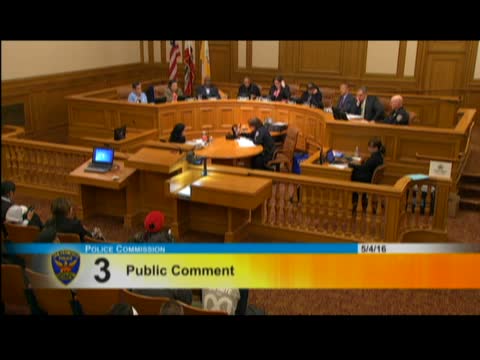
Commission President Susie Loftus on May 4 opened a hours‑long review of proposed revisions to the San Francisco Police Department's use‑of‑force rules, asking commissioners and stakeholders to weigh in on whether the city should adopt stricter standards for when officers may use force and whether electronic control devices (ECDs), commonly called Tasers, should be deployed at all.
The commission, meeting in San Francisco, heard presentations from a broad set of stakeholders — including the Bar Association, the ACLU, the Coalition on Homelessness, the Office of Citizen Complaints and outside consultants — who urged several changes to the draft general orders. Multiple presenters recommended replacing 'objectively reasonable' language with a 'minimal reliance on force' standard and inserting mandatory 'shall' language requiring officers to use de‑escalation techniques "when feasible and safe." Jennifer Friedenbach of the Coalition on Homelessness said stakeholders "oppose the use of those weapons" in the department's current context and urged separate, deeper study of ECDs.
Why it matters: The commission is attempting to recast how officers are trained and reviewed, moving from a narrow moment‑of‑force assessment toward a model that examines an officer's decisions and tactics over the entire encounter. That shift — grounded in what some speakers called the Hayes California Supreme Court approach and a "critical decision‑making" framework — would affect training, data collection and discipline.
What commissioners discussed: Loftus asked staff to prepare alternative drafts that would reflect the two poles in comment letters: (1) a version that restores earlier department language and seeks to preserve flexibility for officers, and (2) a stakeholder‑preferred version that inserts 'minimal reliance on force' and mandatory de‑escalation. Commissioners also debated adding explicit proportionality language, requiring supervisor response for calls involving weapons, and codifying restrictions on shooting at vehicles.
On ECDs: The department presented a draft bureau order to authorize ECDs for a limited number of specially trained officers (roughly 100 specialists and SWAT members). Stakeholders split: police‑employee groups argued for broader patrol use; community groups and oversight advocates urged delaying any ECD decision and insisted on independent medical and operational review. Chairman Loftus said the commission will not vote until it receives written guidance from the U.S. Department of Justice and additional input from PERF and other experts.
Public comment and data: The Commission agreed to produce two working versions of the policies for public review and to host at least two community meetings before any final vote; staff were also directed to add explicit quarterly data‑reporting requirements to the draft so the public can monitor use‑of‑force trends.
What's next: Commissioners asked staff to produce redlines that show the 'minimal' and 'reasonable' alternatives, clarify where the City Attorney made drafting edits, and return with DOJ and PERF recommendations. Two community meetings were scheduled in June and the commission will not adopt final policy until after public input and agency reviews.
Ending: No final policy vote or ECD authorization occurred on May 4. The commission requested additional written analysis and a revised set of draft orders before further action.