Get Full Government Meeting Transcripts, Videos, & Alerts Forever!
Get email alerts on the Transit Site Selection topic
No spam. Unsubscribe anytime.
Working group approves site-selection criteria for Lawrence downtown bus hub after debate over restrooms, parking and historic-area impacts
Summary
A Lawrence site-selection working group voted to forward proposed criteria for a downtown bus hub to the city commission after discussing public feedback, restroom access, parking impacts, historic-context constraints and how to weight evaluation factors; the group approved the criteria and will present them to the commission in August.
Members of a Lawrence site-selection working group approved a package of evaluation criteria for a proposed downtown bus hub and agreed to forward the standards to the city commission for consideration at its first August meeting.
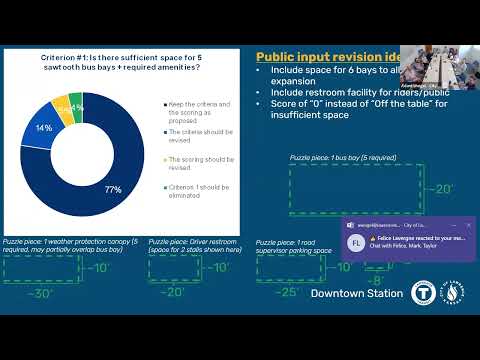
The group’s presenter (Speaker 2) told attendees that the public comment period had closed and staff received 117 online survey responses: "So, our public comment period ended on Friday," the presenter said, and reported that roughly 12% of responses opposed the project while most respondents supported advancing the criteria as written. The presenter also said the step-3 survey remains open through Aug. 15 and staff will prepare site packets and scoring to share before the next meeting.
The meeting focused on several recurring public concerns that shaped the final discussion. The first major debate centered on whether restrooms on a selected site should be driver-only or include public access. The presenter described the baseline: "These are individual stalls. They're large enough for wheelchair access. They have a changing table. They're 10 by 10 each," and participants weighed operational and cost implications. Several members worried about cleaning, security and potential misuse; others argued public restrooms would be important for riders and families. The group agreed to preserve driver restrooms as required and to consider a separate sub-criterion or bonus points for sites that also provide public restrooms.
Panelists also discussed parking impacts and how to count lost or gained spaces. Some speakers urged calculating net automobile-parking changes alone to keep the metric focused on a perception downtown business owners raise; others said bicycle parking and other modal changes should be included. On the question of whether to exclude three specific parking lots from consideration, the presenter explained the state advised against including those lots because of grant- and public–private partnership complications and identified the three lots by number and location during the meeting.
Several attendees raised concerns about siting the hub inside historic-context areas. The presenter said being in a historic zone is not categorically disqualifying but would require more mitigation and could increase construction costs. One participant who identified himself as Gary Weber, president of the Sunset Hill Neighborhood Association, argued in favor of keeping the hub close to downtown destinations: "What you're talking about here is a downtown bus transit hub... Proximity is critical for those of us who use the bus," and he warned that moving the hub to the periphery would disadvantage riders. Weber also said he feared that relocating the hub away from the center could be used to hide people who use transit: "I get this feeling that the justification is that we need to shove the people who use the bus ... away from downtown so that visitors to downtown won't see them." That remark expressed a community concern about equity and visibility; the transcript records no direct factual rebuttal.
The group spent substantial time on the scoring model and weightings. Presenter (Speaker 2) offered an adjusted scoring approach that rescales each criterion so no single factor is multiplied by zero; supporters said the change equalizes criteria for public perception, while skeptics called the multiplicative factor confusing for commissioners and recommended simpler point adjustments. Several members proposed increasing the weight of downtown-context criteria to reflect public priorities.
After the discussion, Speaker 10 moved to approve the site-selection criteria "as presented," Speaker 1 seconded, and the committee conducted a voice vote; the transcript records ayes and no recorded nays. The presenter said staff will prepare site evaluation packets, post them publicly and begin scoring candidate sites; the next related meeting (CircEx) was announced for Monday, Aug. 19.
The working group's action was procedural: it approved the criteria to recommend to the city commission rather than selecting a final site. Staff will apply the criteria to an initial set of sites, report scores and return to the group for detailed site-by-site discussion before the commission takes formal action.