Get Full Government Meeting Transcripts, Videos, & Alerts Forever!
Get email alerts on the Use Of Force topic
No spam. Unsubscribe anytime.
San Francisco Police Commission delays action on new use-of-force rules as DOJ review and taser debate intensify
Summary
The Police Commission paused final action on draft use-of-force general orders after the U.S. Department of Justice asked for more time. Stakeholders remain sharply split over policy language ("minimum reliance" vs. "reasonable force") and whether to authorize conducted energy devices (tasers).
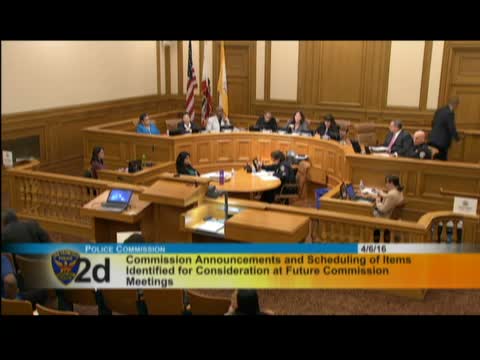
The San Francisco Police Commission on April 6 postponed final steps on comprehensive draft use-of-force rules after the U.S. Department of Justice asked for extra time to review the documents, prolonging a process that has already exposed deep divisions among community groups, police unions and city oversight bodies.
Commission President Loftus told the meeting that the DOJ asked for more time to provide recommendations on several contested provisions. Deputy Chief Chaplin summarized the department's timeline and said the drafts and 18-member stakeholder working group reduced an initial set of roughly 65 comments to 24 non-consensus items, with about 10 major sticking points remaining.
Why it matters: the orders under discussion would replace or revise several Department General Orders covering use of force, firearms, use-of-force reporting and a new bureau order on conducted energy devices (CEDs). Those policies define when officers may point firearms, the department's approach to de-escalation and which tools are authorized in patrol work. Changes could reshape training and accountability at the department and are likely to be central in any consent-decree-style reforms that the DOJ recommends.
Stakeholders divided over standard and mandates
Representatives from the Office of Citizen Complaints commended the department for building de-escalation into the drafts but urged stronger, mandatory language. "Make the policies mandatory," Samra, appearing for the OCC, said, arguing the difference between "shall" and "should" matters for on-the-ground accountability. The OCC also urged the commission to restore language committing the department to a "minimum reliance on force" standard and to put public reporting of use-of-force data into the general order itself.
Civil-liberties and community groups likewise urged stronger, prescriptive language. Jennifer Friedenbach of the Coalition on Homelessness asked the commission to remove electronic-control weapons from the orders and to operationalize the crisis-intervention team before adopting new force rules.
The Police Officers Association presented an alternate proposal and defended aspects of the draft that emphasize officer safety. "We welcome change if it is beneficial to the community that we serve and it protects the officers that are out there day in and day out," Martin Halloran, POA president, told commissioners, and the union provided a written policy draft for the commission and other stakeholders to review.
Taser/CED dispute highlighted
One of the most contentious items was the draft bureau order covering conducted energy devices. Several community speakers called for excluding CEDs entirely; other speakers, including on-duty officers, argued that tasers are a useful nonlethal option and should be issued to patrol officers rather than restricted to specialized units. Officer Brian Nuker, representing an officers'association, said CEDs are "a useful tool for patrol" and urged broader equipping of officers; protesters and coalition representatives countered that CEDs have caused deaths and escalation in other jurisdictions.
Policy wording and the standard for pointing a gun also drew close scrutiny. OCC representatives and some advocates argued that pointing a firearm should be reportable only when there is a risk of death or serious bodily injury, not whenever an officer says they feared for safety; the OCC recommended aligning field training guidance and the general order with that higher standard.
Public pressure and high-profile incidents
Public comment at the meeting was intense and sustained. Scores of members of the public cited recent deaths and racialized officer text messages to argue that the department needs stronger standards, better data sharing and independent investigation. Several speakers asked the commission to request a civil-rights inquiry; Public Defender Adachi said he had asked Attorney General Kamala Harris to open such an investigation under the Code of Civil Procedure provision noted in his letter to the AG's office.
Next steps
Commission leaders said they will reschedule planned community meetings and hold additional stakeholder sessions once DOJ returns its recommendations. The commission vacated a community meeting scheduled for the following week and directed staff to work with the DOJ and stakeholders to set a new timeline. Any draft adopted by the commission would then proceed through the city's meet-and-confer process with the POA and through the Department of Human Resources as required by law.
The commission emphasized that the pause is procedural: DOJ input will be incorporated before the commission votes on any final order.
Ending: The commission closed public comment and voted to hold a related personnel matter in closed session; commissioners then voted not to disclose the closed-session discussion. The use-of-force drafts remain under active review pending DOJ recommendations.