Get Full Government Meeting Transcripts, Videos, & Alerts Forever!
Get email alerts on the Open Government topic
No spam. Unsubscribe anytime.
Town attorney briefs Oakland volunteer boards on sunshine, public‑records, conflicts and quasi‑judicial rules
Summary
Town attorney Wade Moss led a training for Oakland volunteer board and commission members reviewing Florida open‑meetings and public‑records law, voting‑conflict rules and quasi‑judicial procedures, stressing disclosure duties, record retention and the risks of out‑of‑meeting deliberations.
Town of Oakland volunteer board and commission members attended a legal training led by town attorney Wade Moss of the Bose Law Firm that reviewed Florida’s open‑meetings (sunshine) law, the public‑records act, statutory voting‑conflict rules and quasi‑judicial hearing procedures.
Moss opened the session by summarizing the agenda and noting that the presentation was an overview and not the full four‑hour ethics course boards sometimes take. “So first of all, I wanna just note that this is not the 4 hour training that town commissions have to take every year,” he said, adding the session would focus on issue‑spotting and practical steps attendees should take when questions arise.
Why it matters: The training covered routine but consequential duties for volunteer board members — when and how meetings must be noticed and open to the public, what communications may count as an unlawful meeting, which materials are public records and when board members must disclose and refrain from voting because of conflicts. Moss framed the rules as safeguards that help the town avoid legal exposure and preserve due process for applicants.
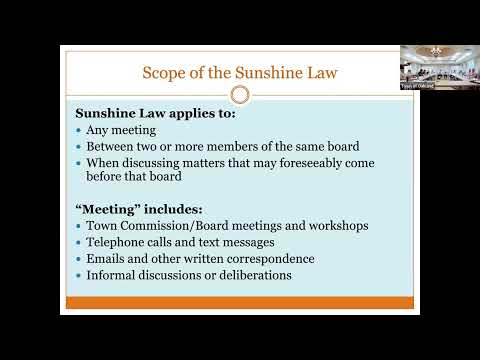
Open meetings and communications: Moss explained that the sunshine law applies to “meetings of collegial bodies at which official acts are taken or public business is transacted,” and warned that substantive communications about foreseeable board business between two or more members outside a noticed meeting can constitute an unlawful meeting. He cautioned members to avoid back‑channel deliberations by text, email threads or social‑media exchanges on matters that may come before their board.
Public records and retention: On public records, Moss said the right of access flows from the Florida Constitution and chapter 119, which broadly defines records to include materials made or received in connection with official business regardless of format. He told members that emails relating to town business sent to personal accounts are still public records and recommended forwarding such messages to the town email system so the records custodian can retain them. “Don’t put anything in writing,” Moss told the room in a cautionary admonition about informal notes and messages that can become public evidence.
Anecdote and practical consequences: Moss used a past incident to underscore risk: he described a brief note exchanged during a heated meeting that read, according to his account, “you are going to regret that,” which was photographed and published — a reminder that even small written communications on the dais can prompt sunshine‑ and public‑records scrutiny.
Voting conflicts and disclosure: The attorney reviewed voting‑conflict rules in chapter 112, explaining they apply to elected and appointed public officers, including advisory board members. He ran through key definitions — principal (employer/client), covered relatives (a defined list), and business associates — and said officials must abstain when a measure will inure to their special private gain or loss. He noted practical steps: an officer who recognizes a conflict must disclose it orally before the vote and file a written disclosure within 15 days. Moss also contrasted that duty with the general obligation under chapter 286 to vote when present, stressing that abstention is narrowly permitted only for conflicts or the appearance of conflicts.
Quasi‑judicial procedure and ex parte contacts: On quasi‑judicial hearings — decisions that apply policy to an individual property — Moss emphasized the due‑process requirement that decisions be based on competent, substantial evidence presented at the hearing. He advised members to disclose any pre‑hearing contacts or information at the start of a quasi‑judicial proceeding and to avoid relying on undisclosed evidence when making decisions. Using a recurring example of a hypothetical “chicken farm” rezoning, Moss explained the difference between legislative policy choices (what the town allows in general) and quasi‑judicial adjudications (how rules apply to a specific applicant).
Permits, PUDs and developer agreements: Participants and Moss discussed how planned unit developments and developer agreements can impose more detailed, binding entitlements than a straight zone change, and why reading development agreements carefully matters when evaluating future allowed uses.
Questions and next steps: The training included audience questions about conflict scenarios, social‑media handling and when to raise legal issues with counsel. Moss repeatedly encouraged board members to “pick up the phone” and call the town attorney for guidance on particular facts rather than guess. The session concluded with a brief Q&A; no formal actions or votes were taken.
What remains: Moss urged caution — avoid back‑channel deliberations, forward town‑related emails to official accounts for retention, disclose conflicts promptly and keep quasi‑judicial decisions grounded in the evidence presented at hearing — as practical ways board members can reduce legal risk and preserve public trust.