Get Full Government Meeting Transcripts, Videos, & Alerts Forever!
Get email alerts on the Land Use Recovery Residences topic
No spam. Unsubscribe anytime.
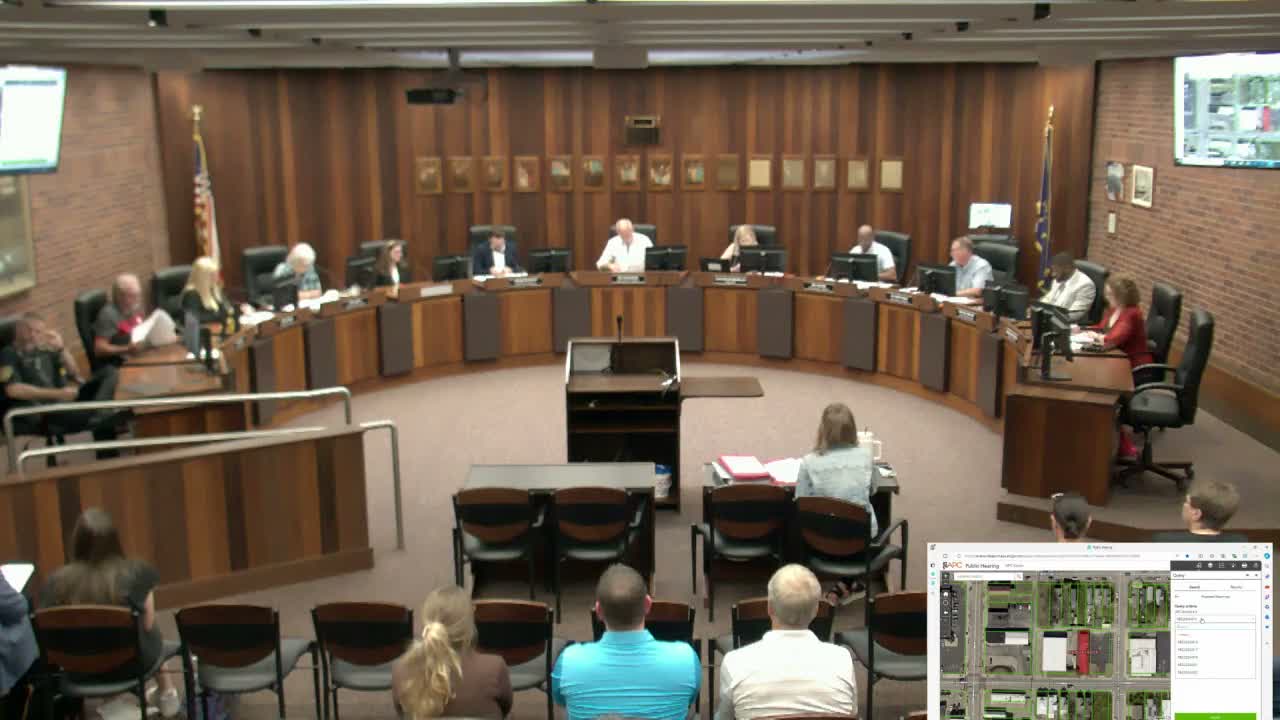
After heated public comment, Evansville council denies two rezoning requests for recovery residences
Summary
Following extended public testimony about neighborhood density and safety, the Evansville Common Council on July 22 denied Ordinances R-2024-16 (971 E. Blackford) and R-2024-17 (819 E. Powell), both proposed to allow higher-occupancy recovery residences; council votes were 1–7 for each denial.
The Evansville Common Council on July 22 voted down two rezoning petitions seeking to permit larger recovery residences in established neighborhoods, after more than an hour of debate and public testimony.
Area Plan Commission staff Cassie Virgin described the zoning rationale: the petitioners sought R4 zoning to classify the properties under use-group 6 (group homes or boarding-house style supervised living), a category the current Evansville zoning code does not explicitly modernize for recovery residences. Staff noted that under existing zoning a single-family unit is allowed to house up to five unrelated persons, and that a prior use-development commitment (UDC) limited one property to 10 residents.
Petitioners and their consultants (Matt Layman of Layman and Son Consulting; Jordan Milby of New Opportunities for Wellness) said the rezoning would legalize occupancy patterns and allow supervised recovery services. Neighbors urged the council to reject rezoning tonight and instead develop a citywide policy. Residents described concerns including clustering of recovery houses, parking and infrastructure impacts, and allegations that some nearby houses housed registered sex offenders.
Council members expressed a mix of positions but a majority said they were uncomfortable with the proposed density and argued the city needs a comprehensive policy framework. Councilman Hieronymus was the lone vote in favor on both measures and said he supports second-chance programs while acknowledging neighbors’ concerns. Council members who voted no cited the need for a strategic plan with occupancy or distance requirements and indicated commercial properties might better host consolidated recovery services.
Roll-call outcomes: Ordinance R-2024-16 (971 E. Blackford) was denied 1–7 (Hieronymus in favor); Ordinance R-2024-17 (819 E. Powell) was denied by the same margin. The council chair and staff clarified that, in many cases, rejecting the rezoning would not immediately displace current residents because single-family zoning allows limited unrelated occupancy (five per unit) and existing UDCs or permit histories can limit or permit certain configurations.
Councilmembers repeatedly directed staff and APC to continue work on an overarching ordinance and recommended forming a task force to study definitions, occupancy caps, distance rules and enforcement mechanisms before future petitions are considered.