Get Full Government Meeting Transcripts, Videos, & Alerts Forever!
Get email alerts on the Eab Management Identification topic
No spam. Unsubscribe anytime.
How to spot and respond to Emerald Ash Borer, according to Minnesota Department of Agriculture guidance
Summary
MDA staff summarized how to identify Emerald Ash Borer (S‑shaped galleries, larvae with two tail spines, adults and D‑shaped exit holes), recommended when to treat or remove trees, outlined treatment options (professional emamectin trunk injections, homeowner soil drenches), and urged residents not to move firewood.
The Minnesota Department of Agriculture on Tuesday laid out practical guidance for identifying Emerald Ash Borer (EAB) and options for homeowners and communities managing ash trees. Jonathan Austis, MDA’s Emerald Ash Borer technical assistance coordinator, emphasized early detection and safe wood handling as the most effective public measures.
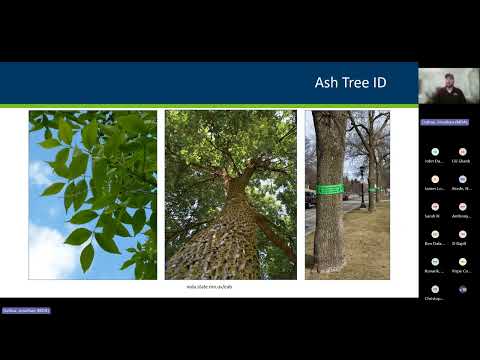
Identification and early signals: Austis said there are four main ways to identify EAB: distinctive S‑shaped larval galleries under the bark, larvae with two small tail spines, the adult beetle’s bright iridescent green elytra and reddish abdomen, and the D‑shaped exit hole adults leave when they emerge. He highlighted woodpecker feeding (flecking and dime‑sized shallow holes) and blonded bark patches in the mid‑to‑upper canopy as the most useful early indicators and recommended winter or early spring canopy checks when leaves are absent.
"Early detection is really important," Austis said, noting infestations can be cryptic for years before canopy decline is evident. He advised that if a suspect exit hole is found, removing bark at the site to look for the S‑shaped gallery is a more reliable confirmation than searching for the adult beetle.
Treatment and removal decision factors: The MDA recommends communities and homeowners weigh four considerations when choosing removal or treatment: how close EAB is (treat once within roughly 10–15 miles of a known infestation), the health and location of the tree, the tree’s size (larger trees are costlier to remove; trees greater than 15 inches diameter at breast height are recommended for professional treatment), and how many ash trees must be managed. Austis said a tree remains a viable candidate for insecticide treatment if at least 70% of the canopy is healthy; beyond that threshold it is often too far gone to restore.
Treatment methods and intervals: Professional trunk injections using emamectin benzoate are commonly used on large trees; Austis said those injections "are guaranteed for 2 years" before reapplication is needed. Homeowner options such as soil drenches (often with imidacloprid and other neonicotinoids) may be effective but typically require annual reapplication and carry groundwater and pollinator considerations. Austis recommended professional treatment for large mature trees and advised communities may adopt a three‑year regimen in some cases to stretch budgets, while individual trees in high‑pressure areas should follow a two‑year cycle.
Costs and community programs: Austis estimated professional treatment typically costs about $10–$12 per diameter inch for homeowners, though some communities that treat in‑house can reduce costs to roughly $4 per inch. He also outlined DNR resources such as the Forest Stewardship Program and an Urban and Community Forestry grant program that provides funds for removals, replacements, or inventories; MDA urged municipalities to consider inventories and management plans before infestations escalate.
Biological control and long‑term outlook: MDA runs a biological‑control program that has released three species of EAB‑specific parasitoid wasps since 2010. Releases are limited to sites with at least 40 contiguous acres and a minimum 25% ash component where EAB is present; Austis said parasitoids are unlikely to prevent the initial wave of large‑tree mortality but could help sustain ash in natural settings over the long term.
Public messaging and reporting: Austis reinforced the agency’s public message to "buy where you're gonna burn it" and avoid moving firewood long distances; he asked residents to photograph suspected symptoms (tunneling galleries, woodpecker damage, D‑shaped exit holes) and report them to MDA’s online "Report a Pest" form or through EDDMaps to enable early detection and more effective local response.