Get Full Government Meeting Transcripts, Videos, & Alerts Forever!
Get email alerts on the Zoning topic
No spam. Unsubscribe anytime.
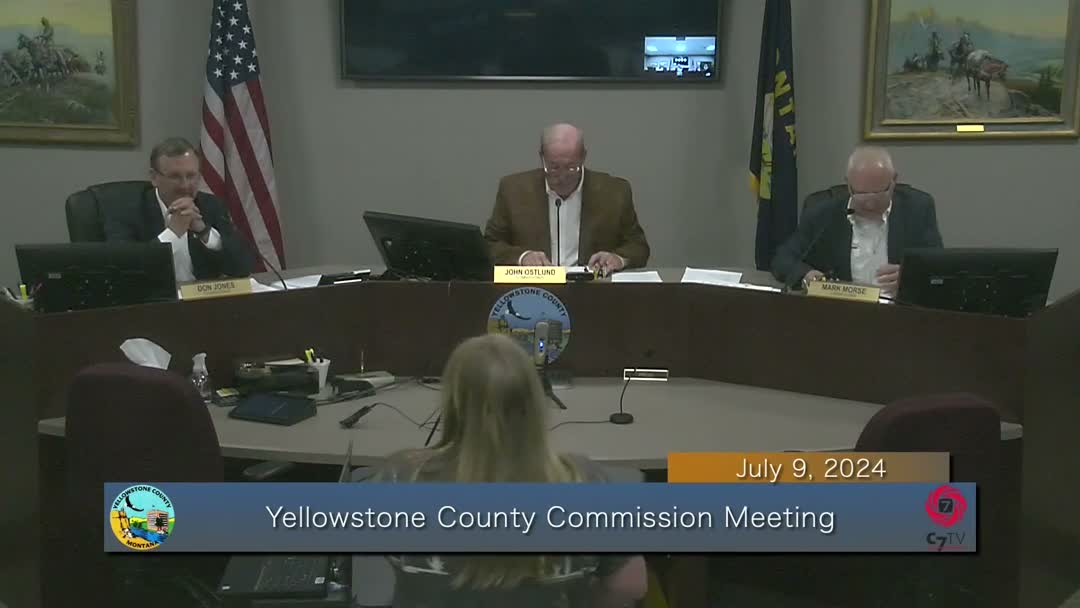
Commissioners reenact jurisdictional zoning around Laurel amid heated public opposition over Northwestern Energy plant
Summary
The board voted to enact historical jurisdictional zoning around the city of Laurel (Resolution 24‑116) after a staff presentation; the hearing featured widespread public opposition focused on Northwestern Energy’s methane-fired plant, with speakers raising air-quality, public‑process, and recusal concerns.
The Yellowstone County Board of County Commissioners on July 9 approved Resolution 24‑116 to enact jurisdictional zoning in the one-mile area around the city of Laurel, a move staff said simply reestablishes zoning that residents and property owners had long believed was in place.
Monica, a county staff member, told commissioners a legal judgment had shown a lack of records proving that previously believed zoning had been enacted; without action, land around Laurel remained unregulated. The presentation summarized historical maps (including a 1979 map), explained that staff sought to reenact historical Part 2 zoning administered by the county (not to rezoning individual parcels), and noted specific map clarifications: a parcel with mixed heavy industrial/agriculture/unzoned designations near Lindy Lane and Stroud Road; a Highway 212 parcel historically mapped as heavy industrial; and a CHS-owned tract where a 2015 county resolution (15‑78) had preserved an agricultural buffer that the earlier public‑hearing maps had not shown correctly. Monica said the map errors were corrected in the material before the board.
The public hearing drew extensive testimony from residents, organizers and subject-matter speakers opposing the practical effect of reenacting the zoning because Northwestern Energy has built (and is operating) a large methane-fired generation plant at the site. Speakers cited health and air-quality concerns and alleged procedural failures and bias:
- Steve Crumb (Laurel) urged the county to follow statutory requirements for a current growth policy and suggested commissioners were acting ahead of a proper planning process; he asked that Commissioner Oslund recuse himself from related decisions.
- Christine Lehi, chair of Yellowstone Valley Citizens Council, said air pollution “kills,” listed pollutant tonnage figures attributed in testimony to the plant (e.g., formaldehyde, particulates, volatile organic compounds) and asked commissioners to “hold Northwestern to the letter and the intent of the law.”
- Other speakers (including Mary Fitzpatrick, Priscilla Bell and Mary Catherine Dunfee) alleged a lack of timely public process, raised health and financial impacts, and questioned whether the county had privileged Northwestern with back‑channel assurances. Several asked the board to halt the process pending updated growth‑policy data or pending resolution of lawsuits they said were related to the plant.
Several speakers proposed alternatives for grid reliability, including pumped-storage hydropower and expanded solar; however, county staff emphasized that zoning is a land‑use decision and environmental permitting and compliance questions are handled by the Department of Environmental Quality (DEQ).
After public comment, a commissioner moved to approve Resolution 24‑116. Commissioners asked staff to confirm that the action was a reenactment of historical zoning (not a rezoning of individual parcels) and that DEQ is responsible for environmental oversight. Staff (identified as Steve in the transcript) confirmed those points. The motion carried by voice vote with all commissioners saying “Aye.”
The action enacts county jurisdictional zoning around Laurel; opponents requested further procedural steps, recusal by specific commissioners, and further review of environmental and public‑health consequences. The DEQ retains responsibility for air‑quality permitting and enforcement; the zoning action does not itself authorize or deny environmental permits.