Get Full Government Meeting Transcripts, Videos, & Alerts Forever!
Get email alerts on the Cbsip Tunnel topic
No spam. Unsubscribe anytime.
SFPUC staff recommend 24‑foot Central Bayside tunnel to reduce sewer discharges and increase resilience
Summary
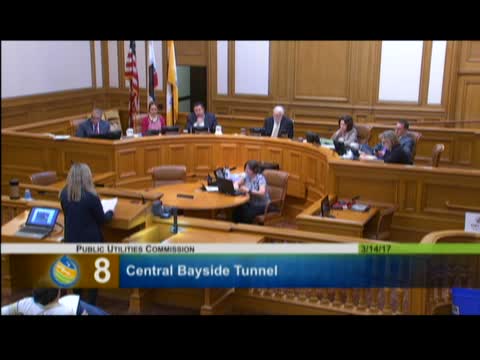
SFPUC staff told commissioners on March 14 that a 24‑foot diameter tunnel best balances current regulatory limits, future flexibility and seismic reliability for the Central Bayside System Improvement Project; staff will proceed with 35% design and return with further briefings and alignment options.
San Francisco Public Utilities Commission staff recommended on March 14 that the Central Bayside System Improvement Project include a 24‑foot diameter tunnel to address a vulnerable channel force main, reduce combined sewer discharges (CSDs) and provide flexibility for likely future regulatory tightening.
Dan Donahue, the program management technical advisor, said the existing channel force main conveys 70 percent of dry‑weather flow to the Southeast plant, is over 40 years old, has failed in the past and sits in a liquefaction zone. "The 24 foot tunnel ... provides an additional 40,000,000 gallons of storage for the bayside, which is about a 30% increase over the existing storage capacity," Donahue said while reviewing hydraulic and receiving‑water modeling.
Staff modeling indicated the city now discharges roughly 12 times per year in the Central Bayside; earlier modeling and permit limits target 10. Donahue said tunnels of roughly 17 feet already get the system to about eight discharges under current criteria, but future regulatory demands — which staff characterized as plausibly in the 0‑to‑2 discharges‑per‑year range — require the larger tunnel plus the option to add high‑rate treatment later. He noted that a 17‑foot tunnel would save about $120 million in capital cost but would not provide the same long‑term regulatory headroom.
The staff analysis compared a 24‑foot tunnel (estimated capital cost staff cited at about $690 million) against a suite of alternatives: increasing treatment capacity with a smaller tunnel plus high‑rate treatment, routing flows offshore (a Crosstown Tunnel concept that added roughly $900 million and regulatory complications), and deploying extensive green infrastructure on bay‑side parcels (staff estimated about $640 million to reach a modest reduction). Donahue said those comparisons and the need for a 150‑year asset life led staff to identify the 24‑foot diameter as the preferred option.
Commissioners questioned how green infrastructure and private‑parcel stormwater measures factored into the analysis; Donahue said private‑parcel opportunities and grant‑funded elements will be included in follow‑on briefings next month but that those additions did not change the technical conclusion favoring the 24‑foot tunnel. CFO Eric Sandler asked about the tradeoff of building a smaller tunnel now and waiting for future regulatory action; Donahue described the tradeoffs that led staff to prefer the larger tunnel for future flexibility.
Public commenter David Pilpel, who has participated in SSIP advisory work, and several commissioners publicly supported proceeding with 35% design on the 24‑foot basis while noting that full funding and alignment decisions will come later. Staff said the team will complete 35% design this fall and return with subsequent briefings on alignment, construction phasing and flood‑resiliency interactions.
Next steps: staff will continue 35% design on the 24‑foot tunnel, brief the commission again during the spring and summer on alignment and flood resiliency, and present further budgetary decisions for Phase 2 construction funding when appropriate.