Get Full Government Meeting Transcripts, Videos, & Alerts Forever!
Get email alerts on the Early Intervention System topic
No spam. Unsubscribe anytime.
Commission raises alarm over Early Intervention System after department says only six officers received interventions in 2015
Summary
At its March 9 meeting the San Francisco Police Commission pressed SFPD officials for more data and oversight of the Early Intervention System after the department said 384 members triggered alerts in 2015 but only six received interventions; commissioners and public speakers called for audits and a dedicated hearing.
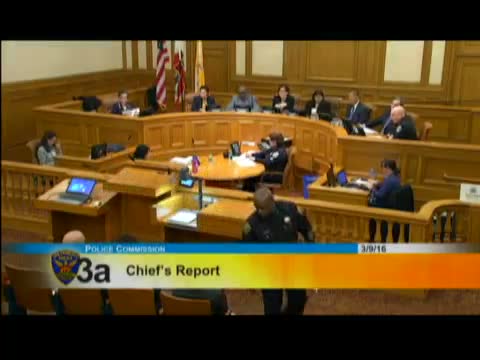
San Francisco Police Commission, March 9 Sergeant Youngblood, who leads the department's Early Intervention System (EIS) office, told the commission that in 2015 the EIS produced alerts for 384 members but that only six of those were placed on an intervention track.
"For 2015, for the year of 2015, we had 384 members that were that triggered an alert. And of those, 6 members were put on intervention," Sergeant Youngblood said, citing the department's internal counts.
The statistic drew immediate concern from commissioners and members of the public. John Crew, a longtime commenter, told the panel, "Honestly, I was shocked to hear that the intervention rate was less than 2 percent," and urged that the commission review audit records and the underlying data.
Why it matters: the EIS is intended to identify at-risk behavior early and offer non-punitive supports such as coaching, counseling, monitoring or voluntary mental-health referrals. Commissioners said the low intervention number raised questions about whether alerts are being reviewed, whether the thresholds trigger too late, and whether the program's audits and public reporting are being performed as required.
How it works: Sergeant Youngblood summarized EIS thresholds and workflow: triggers include uses of force, officer-involved shootings, OCC complaints, civil suits, on-duty accidents and vehicle pursuits; associated indicators include commendations, arrests, citations and stops. Thresholds cited in the presentation included three documented uses of force in a three-month period; five primary/associated events in six months; and a one-year threshold of six indicator points or four OCC complaints. An officer involved shooting or discharge automatically generates an alert.
Youngblood also described the review process: stations receive an alert and the station's PIP (Performance Improvement Program) sergeant compiles and reviews the event paperwork; if the sergeant concurs there is at-risk behavior, the station proposes an intervention (PIP, retraining, counseling or monitoring) and the EIS office performs a concurrence check. Youngblood said the department currently uses a client-based system called AIM and is moving to a more customizable web-based product supplied by a vendor identified in the presentation as On Target Performance.
Requests for data and oversight: Commissioners asked the EIS office for more transparent reporting and pattern analysis (for instance, whether alerts cluster by station or training cohorts) and asked staff to provide examples of successful interventions. Several commissioners and public speakers said they wanted semiannual or annual audit reports and public access to the EIS panel meetings cited in departmental orders.
Next steps: The commission agreed to calendar a standalone hearing focused on EIS and to ask staff to provide two years of EIS data, audit records, and a breakdown of how often concurrence between station sergeants and the EIS office results in interventions. President Loftus and other commissioners emphasized that the commission intends to continue reviewing the item off the consent calendar to ensure follow-up.
The commission did not take a final action altering EIS thresholds at the meeting; it instructed staff to return with additional data and scheduled a dedicated EIS review at a future meeting.