Get Full Government Meeting Transcripts, Videos, & Alerts Forever!
Get email alerts on the Use Of Force Tasers topic
No spam. Unsubscribe anytime.
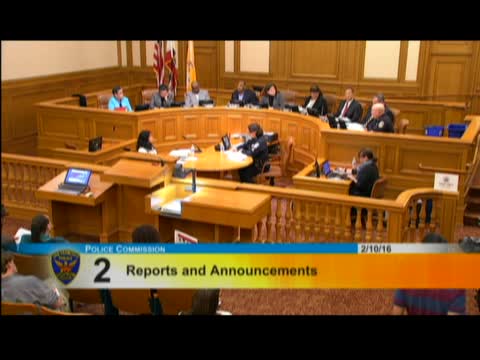
San Francisco Police Commission faces large public outcry over proposal to reintroduce Tasers
Summary
Hundreds of public commenters urged the Police Commission to reject reintroducing electronic control devices, linking the proposal to ongoing concerns about the department's treatment of people of color and calling for independent investigations and expanded crisis-intervention responses.
Hundreds of members of the public used the meeting's public-comment period to press the San Francisco Police Commission to reject a proposal from the Police Department to authorize limited use of electronic control devices, commonly known as Tasers.
Speakers repeatedly tied the debate to the December 2015 killing of Mario Woods and to long-standing complaints of racialized policing. Paulette Brown, whose son was murdered in 2006, said the city must "give us the same justice for our children" and asked why some cases remain unsolved while others receive rapid attention. Multiple speakers cited studies and international human-rights findings they said show Tasers increase harm and do not reliably reduce police shootings.
The commission heard consistent appeals for nonweapon responses. Jennifer Friedenbach of the Coalition on Homelessness and David Elliott Lewis of the CIT mental-health working group praised crisis-intervention training (CIT) and asked the commission to fund and expand mental-health–led responses instead of equipping officers with more options for force. "Electronic control weapons don't reduce shootings," Friedenbach said, citing independent reviews and UCSF research.
Chief Sir defended the draft orders as emphasizing "the sanctity of all human life," de-escalation, time and distance, and reporting changes. He told commissioners the department is not seeking Tasers for all officers but asked that a small portion of specialist units be allowed the devices in narrow circumstances — for example, when a subject is armed with a weapon short of a firearm. "I'm not asking that the entire department get tasers," he said, describing a request limited to 5 percent of officers for specialized roles.
Commissioners diverged over process. Several — including Commissioner De Jesus and Commissioner Wong — urged severing Tasers from the larger reengineering of the use-of-force policy and addressing them separately because the issue dominates public conversation and could drown out other reforms. President Loftus and other commissioners favored sending the full draft to a stakeholder working group and to the U.S. Department of Justice for review before any vote.
The Commission did not take an up-or-down vote on the Tasers proposal at the meeting. President Loftus outlined a process modeled on the body-camera rollout: send the draft to a working group that includes community stakeholders, transmit the draft to the DOJ for collaborative review, hold two community hearings to gather input, and then bring the orders back to the commission for a final vote, timing dependent on DOJ recommendations.
The meeting made clear deep community skepticism about expanding the department's use-of-force toolkit. Commenters asked the Commission to prioritize transparency, independent investigations, and investments in behavioral-health responses rather than new conducted energy devices. The working group and DOJ review will provide the next opportunities for community members and advocates to influence what, if any, authorization for electronic control devices appears in a final policy.